BBC News · Transcript · · Updated
Colombia earthquake death toll rises above 220 | BBC News – Transcript
Video by BBC News · Watch the original on YouTube
Summary
AI-generated from the transcript. Verify details against the source video.
- The death toll from the 7.4 magnitude earthquake in Colombia has risen to at least 224 people, with nearly 600 injured.
- President Abel de la Espriella declared a state of emergency and visited affected areas including Pereira, Cali, and Chocó.
- While many buildings in Colombia were designed to withstand seismic activity, cities like Cali still experienced dozens of collapsed structures.
Use this video with Pro
Reading, copying and transcript downloads are free. Create saved AI results for this video with a signed-in Pro account ($9/month).
Transcript
Search ignores accents. All transcript text stays visible.
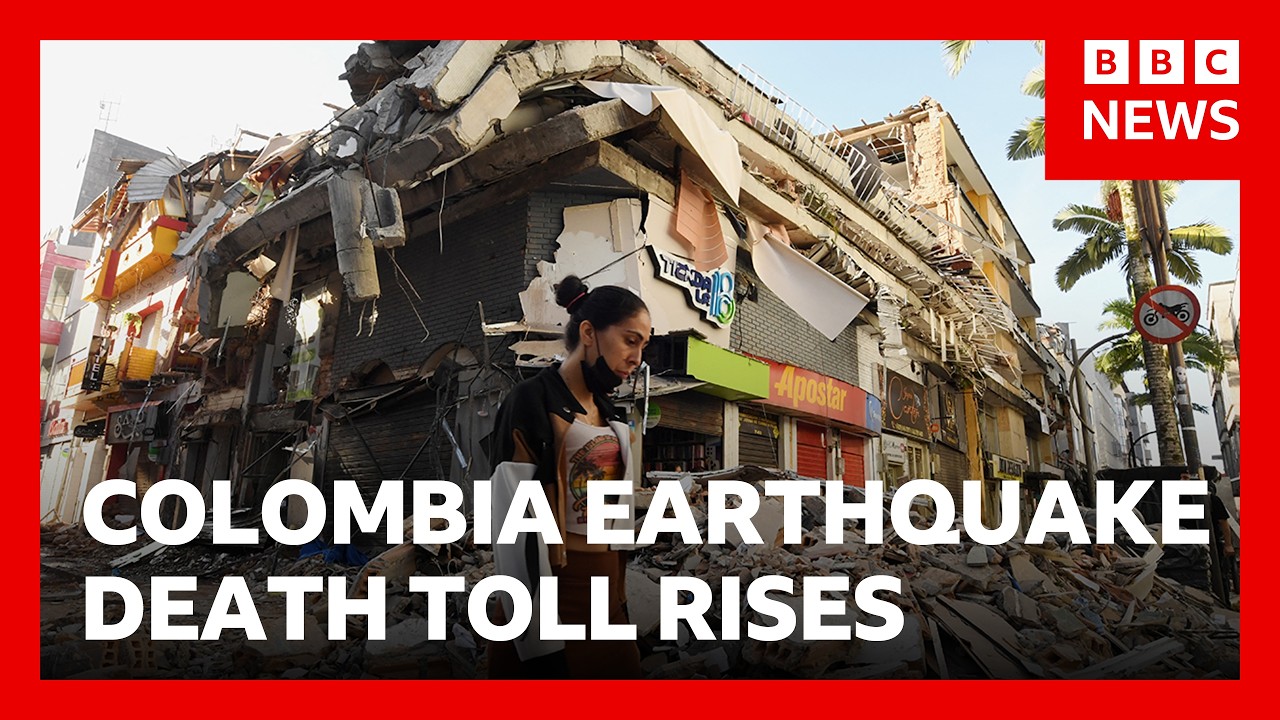
Hello, I'm Lewis Vaughan Jones. Welcome to the program. The death toll after Monday's earthquake in Colombia has risen to at least 224 people as rescue efforts continue among the dozens of collapsed buildings.
Nearly 600 people are injured. Cities of Cali and Pereira were among the worst hit. Well, the 7.4 magnitude earthquake has affected a huge area across the west of the country. It's blocked roads, disrupted communications, and causes is making rescue efforts difficult. Flights have been canceled at some airports because they're being used as part of the rescue effort instead.
Well, the country's president is only a couple of days into the job when this earthquake hit. He's now facing his first major crisis and has declared a state of emergencies. Several countries, including the US, Mexico, and Ecuador, have offered to help.
So, the city of Cali is among the hardest hit areas. The BBC's Jose Carlos Cueto Lopez is there for us. >> Behind me, there is a totally collapsed building with rescue teams hoping to find survivors.
It's a picture familiar where I'm just south of Cali, which is one of the worst hit areas in this disaster. On my way here, I saw several buildings with cracks, rubble on the ground, and smashed windows. We know that dozens have died in Cali alone, and many hope to find their missing loved ones like in this case behind me.
Here in particular, the most tense moments are lived with the rescue teams and total silence in the area in order to be able to hear survivors trapped under the rubble. I have spoken to young volunteers who have been working tirelessly since yesterday, while residents and neighbors are visibly affected and reluctant to talk to the press.
The scene is repeating in other areas in Colombia. Apart from Cali, the coffee growing region in the west of the country is also severely affected by what has been called the worst earthquake in a decade in Colombia.
>> Well, Alfi Panal is a journalist at Latin America Reports. He's also in Cali and gave me this update. >> I think Colombians are in shock, you know, they woke up on Monday morning after a long weekend. They were making their coffee, they were getting ready for work and this very strong earthquake struck and it lasted for 2 minutes and to make matters worse, you know, people in Colombia felt very strongly
the after shocks of of Venezuelan earthquake. They share a 2,000 more than 2,000 km land border with Venezuela. So, you know, the the earthquake was kind of in the back of people's minds already. The response has been rapid. The government has mobilized resources quickly. President Abel de la Espriella, who was inaugurated just last Friday in the city of Cali, has already visited Pereira, Cali and Chocó, the most
affected areas from the earthquake and you can see I've been at the at the rescue site this morning and the response is is really remarkable. You have soldiers, firefighters, police officers and then dozens, hundreds of regular citizens lining up to to put in their two cents and to to really help their their kind of fellow Colombians. So, the the response has
been rapid and people are working, but there are still in the city of Cali, there are almost 300 people reported missing. That number could very easily rise as well as 90 people dead in this city alone. So, this isn't going to end anytime soon.
>> And Alfi, just how prepared are the buildings there? Is the infrastructure there for this kind of earthquake? >> Colombia is is prone to these kinds of events, seismic activity. So, a lot of the buildings are designed to withstand a certain amount of shock. Uh if we compare the effects of this earthquake in Colombia to those in Venezuela, they've been much less,
largely because of architectural and engineering preparations for an event like this. But, there are in the city of Cali alone 30 buildings, potentially more, that have collapsed altogether. So, it's not to say that there aren't buildings that were vulnerable to this this kind of event and that have suffered immense damage. Many hospitals, schools, uh and and other public buildings have also
suffered significant damage. So, that's still being assessed, but Colombia was was relatively prepared for an event like this. >> And what about the the level of communications? Clearly, with events like this, communications are disrupted, being that, you know, internet, phone, roads. Uh but, how significant is it? Is it manageable? Are people still being able to communicate? Are people able to try and piece together and track down loved ones?
>> Yeah, you know, people have mobilized, as we saw in Venezuela, they're using social media, um which is an incredibly powerful tool to disseminate images of loved ones, phone numbers to to contact if anybody's seen them. Um so, there's a lot of information, but there's a a big kind of information inequality in Colombia. So, one of the worst-struck regions, Chocó, it's the most impoverished region of Colombia, uh and it was struck badly, and we're seeing very little information coming out of those areas, largely
because they're rural areas, deep in the rainforest. Uh and also because they're poor areas where people don't have the same kind of access to infrastructure, and the the you know, lower level of development means that the infrastructure is more vulnerable to an event like this. So, we're certainly seeing that Pereira and Cali, Cali is Colombia's third city. Uh Pereira is a very prosperous city in the interior of Colombia. We have a lot of images coming out of there, a lot of
information. But, from Chocó, uh it's it's a bit of a a black hole. >> Our thanks to Alfie Powell bringing us the very latest in the last hour there from Cali.