zhuli · Transcript · · Updated
Why is the Order of Operations the way that it is? – Transcript
Video by zhuli · Watch the original on YouTube
Summary
AI-generated from the transcript. Verify details against the source video.
- The order of operations is a matter of convention and communication rather than an absolute mathematical truth.
- The standard hierarchy of operations resembles precision in real numbers and hyper operations, allowing operations like exponents and multiplication to cover larger gaps before addition.
- Multiplication is prioritized before addition because units must be aligned before they can be added together.
Use this video with Pro
Reading, copying and transcript downloads are free. Create saved AI results for this video with a signed-in Pro account ($9/month).
Transcript
Search ignores accents. All transcript text stays visible.
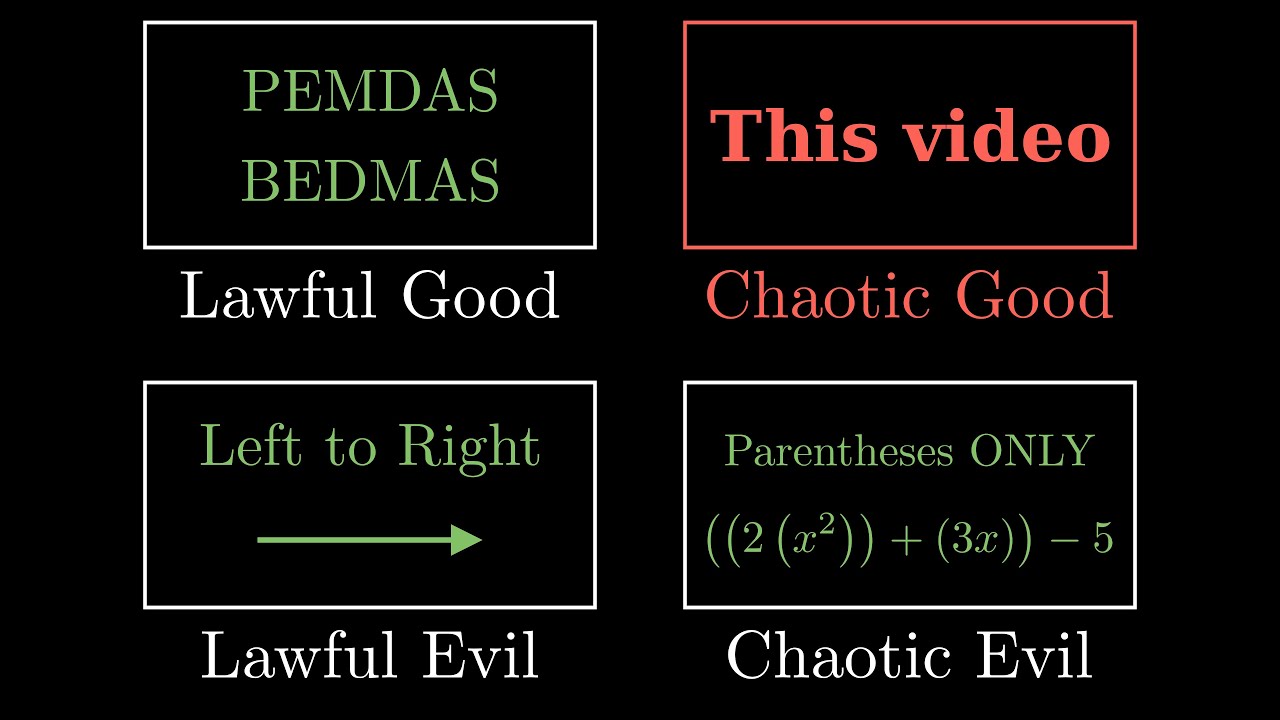
one of the first things you learn in school after knowing your basic arithmetic operations is the order of operations on one hand this makes perfect sense we have a bunch of operations and we have to know which one to do first on the other hand this also seems silly we read from left to right so why don't we just evaluate everything from left to right as well why do we have to come up with a convoluted set of rules for this where does it come from what if we chose not to follow these
rules in this video we will explore multiple reasons in defense of it however hopefully the reasoning will be General enough that you'll understand when and why other order schemes are also valid in addition by understanding the motivation you might no longer need to rely on imperfect pneumonics to remember the correct order you'll just know it before we even begin talking about the order of operations itself we need to First understand that the order of
operations is a matter of convention I not mathematical Truth for any value or expression you want to communicate you have to communicate how that value or expression is obtained it has to be interpreted by others the order of operations doesn't matter as long as all communicating parties agree to some order in the same way that communicating parties should agree on the definitions of words before they use them this is why parentheses despite not
generally considered to be an operation are first on the order of operations parentheses are usually not considered an operation because they're not doing anything to input values they aren't changing the values like if you were to add or multiply however by first placing parentheses on the order of operations we can completely control the order of an expression any way we like parentheses explicitly tell us what comes next no matter what other rules we
set in fact if you use enough parentheses you don't even need an order of operations but would you agree that all of these parentheses are a confus using isore this may be functionally complete but it's difficult to use we add rules to make some of the parentheses unnecessary notice that if we use the standard order of operations our expression can be reduced to this if we use a different order of operations that simply evaluates from left to right our
expression can be reduced to this in this particular example we can see that both cases are about equal using only one pair of parentheses but this isn't always the case look at this expression in which our standard order is superior here is an expression where it's easier to evaluate from left to right basically the rules of our order of operations will determine which parentheses we can safely omit or how we can manipulate the expression we want to choose the order
of operations that proves the most useful by on average removing the most unnecessary parentheses obviously this could vary depending on application but I want to provide some reasons for why the conventional order of operations was established let's take a a quick detour to explain the concept of precision let's say I want to describe this value on the number line how would we do this well we can see it's between 100 and 200 so we know the hundred's digit is 1 we
can now see that the number is between 120 and 130 so we know the 10's digit is two each time we write the next digit we are getting a more and more precise representation of this value this is what makes real numbers so powerfully expressive by this method we can represent any value on the number line with arbitrary very Precision think of this like taking Transportation if you need to go somewhere close by perhaps you only need to walk over if the
distance is long enough you may need to take a plane however the plane won't take you exactly to your destination once you are within a smaller range of your target destination you can switch to a car and once you're within a smaller range you walk the rest of the way now let's talk about how this relates back to the order of operations exponents come first they are like taking a plane as you can see here assuming we are using whole numbers there are massive gaps between
consecutive exponent values if we want to describe this value here we need to be more precise and that requires that we use a smaller operation to get closer multiplication this is like taking a car however this still leaves large gaps these values here cannot all be expressed so now we walk the rest of the way by adding the exact amount needed to reach our destination this makes our order of operations very practical in the same way as as our transportation
example the way we actually Express numbers in for example our usual base 10 representation is a little bit more complicated than that but this is the general idea but what about division and subtraction you might ask we treat division exactly the same way as multiplication because dividing by a value is the same as multiplying by its reciprocal so all divisions can be replaced with multiplication likewise we treat subtraction the same as addition because
subtracting any value is the same as adding its negative this is why in the order of operations multiplication and division are treated as the same priority going left to right and addition and subtraction are treated the same way so we mentioned that exponentiation travels further than multiplication which travels further than addition but why is this here we look at levels of abstraction let's define a successor operation as outputting the number that
comes next if we repeat the successor operation n times it is the same as adding n therefore the addition operation is just repeat succession if we repeat adding the same value n times we are multiplying by n multiplying is just repeated addition and finally similarly exponentiation is repeated multiplication this hierarchy of operations is called hyper operations succession is considered the zeroth
hyper operator addition the first hyper operator multiplication of the second hyper operator and so on you could continue this hierarchy if you wanted to to the fourth hyper operator is called tetration which you may have heard of before the higher the hyper operation the earlier it must appear in the order of operations if you've never heard of dimensional analysis before it might sound really scary and complicated but it's not my last video goes in depth
about what dimensional analysis is and how to apply it so here I'll just give a brief overview but check out my previous video if you want to learn more we know that 3x + 2x = 5x which means that we can substitute any number or expression into X and the equation would be correct but what if I told you that you could actually substitute any dimensional units and it would still hold for example 3 m + 2 m is 5 m $3 + $2 is $5 3
apples plus two apples is five apples almost anything can be considered a unit this means that we can even do arithmetic with these units well sort of we can do three apples plus 2 apples but we can't do three apples plus 2 to oranges As the adage goes you can't compare apples to oranges it turns out that you can't add and subtract arbitrary units together but you can arbitrarily multiply and divide units
length time length represents area length divided by time represents speed mass time length divided time ided time is force dollars divided by apples can represent the price of an apple people times time can represent work hours any units no matter how different can mathematically be multiplied or divided together to obtain a coherent quantity whether or not that new unit representation is useful is a different
matter but it can always be done this explains why multiplication comes before addition we need to First multiply each term so that the units line up and only then can we add everything up take for example this formula for an object's position given its constant acceleration and initial speed if we write out each value in terms of just the units we can see that the units need to First align before we can add the lengths to arrive at an
answer if we go out of order we will get nonsensical units obviously not every expression follows this exact rule but that's what we have parentheses for to explicitly lay out the exceptions when they occur but for a vast number of applications this is the most practical that will results in the largest reduction in unnecessary parentheses you may remember learning in school that a addition and multiplication are associative and
commutative let's quickly review what that means commutative and associative are properties that describe operations commutative essentially means that you can rearrange the order of the terms and the value won't change in particular that this statement is always true associative essentially means that you can place the parentheses anywhere and the value won't change in particular that this statement is always true we also know that multiplication
distributes over addition meaning this statement is always true why did I bring up these properties take a look at the following expression we can apply our properties to simplify this expression further like this these arithmetic properties are at the core of what makes so much of math easy to compute and work with these properties are so fundamental that many people are constantly applying them without realizing it now let's assume we are using a modified order of
operations where we evaluate only from left to right by default notice that applying any of our properties is significantly more convoluted and less intuitive this is another reason why our standard order of operations is so nice it makes Expressions easier to manipulate according to their algebraic properties if you're not convinced that these expressions are or aren't equivalent then sit back and enjoy these
next few animations that demonstrate
saying that that polinomial are ubiquitous in math is almost an understatement most functions that generally behave regularly can be approximated by polynomials which makes them exceptionally useful in many engineering applications even in combinatorics and number Theory fields that some may not expect to see many pols they are used in many very versatile ways the space of pols basically encodes the essence of
addition and multiplication and they are very well understood pols especially benefit from the order of operations notice that no parentheses are necessary if the order of operations was changed to be from left to right we would need parentheses in all of these places polom are far from the only application that benefits from the order of operations but they should be familiar to many math students and they are a mathematical use case that is prevalent across almost
every field of math making them a perfect practical example of where the order of operations helps us a lot so why is the order of operations the way it is because that's the convention we selected that is the most practical and the most useful in most applications if you want a different order of operations for a specific use case such as going from left to right you're welcome to choose any rules you want as long as you make it perfectly clear to anyone else reading your work
and you're careful not to make incorrect assumptions the important lessons here are the reasons why we chose the standard that we did most importantly remember that the order of operations is not about mathem rical truth but about the ability to accurately and rigorously communicate despite being one of the first math concepts taught to students around the world very few people understand why the order of operations is the way it is as a kid I also wondered who came up with these rules
and why by the time I was old enough to understand I had taken these foundations for granted hopefully this video has convinced you that there are some very good reasons for it and you can walk away with an appreciation for the foundations you may have also taken for granted the arguments I've listed here are probably not even comprehensive if anyone has any other reasons to share or even reasons or contexts in which alternative orders are better please share them in the comments below I am
very passionate about explaining simple math and logical ideas that are not often explained or taught and if you appreciate my work you might also appreciate the sponsor of this video brilliant.org brilliant.org is a learning platform that offers a wide range of interactive lessons in math as well as data science and computer science that cater to all levels whether you're a beginner or an advanced student they update their website with new content every month so there's always something new to learn