CNN · Transcript · · Updated
I've studied 1000's of data points. Here's my midterm prediction. – Transcript
Video by CNN · Watch the original on YouTube
Summary
AI-generated from the transcript. Verify details against the source video.
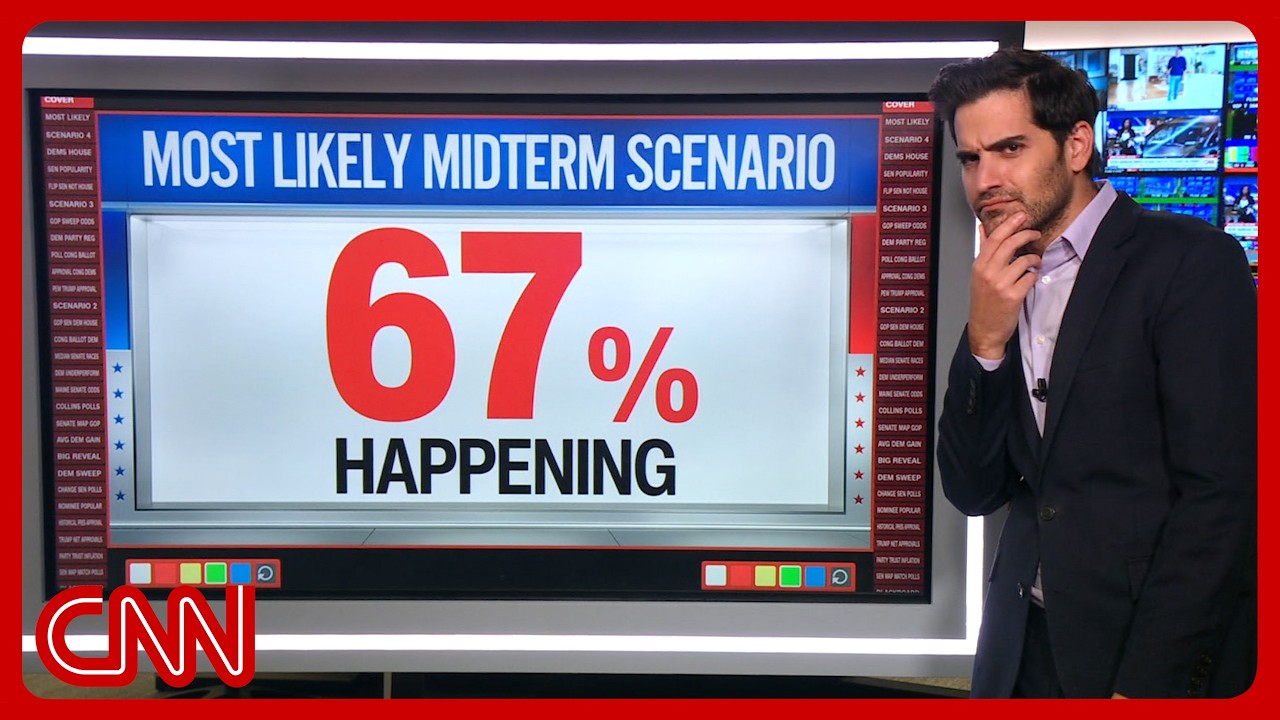
- The most likely midterm election scenario has a 67% chance of happening, representing a Democratic sweep of both the United States House and the United States Senate.
- The least likely scenario is a Republican House and a Democratic Senate, coming in at just less than a 1% possibility.
- A GOP sweep comes in at an 11% possibility, and its odds have decreased four points since August.
Use this video with Pro
Reading, copying and transcript downloads are free. Create saved AI results for this video with a signed-in Pro account ($9/month).
Transcript
Search ignores accents. All transcript text stays visible.
It's prediction time, we're less than a month to the midterm elections, we have the latest numbers to know who's going to win, who's going to lose, we've lifted thousands of data points. These are the updated stats as they stand right now and what is the most likely midterm scenario? Well it has a 67% chance of happening and that chance is going up through the roof because just take a look here.
The most likely scenarios odds have increased 15 points since the last time we did this back in August from 52%, only a bare majority of now 2 in 3, 67%, my goodness gracious. But of course to understand what the most likely scenario is, we have to know what the least likely scenario is.
And so we start off with scenario number 4 and that is a Republican health house and a Democratic health senate and that comes in at just less than a 1% possibility. Not very likely at all. But hey, it's still possible. How could it happen? Well, okay, take a look at the latest NBC News poll, the generic house ballot.
Look at this. It has the Democrats only up by just 1, 2, 3, 4 points if this happens. Your Democrat election night, you definitely want to be calling up. You want to be going, what the heck is going on? And I will note that that my dear friend is in fact right within the margin of what Democrats need in order to actually win back the United States House given the redistricting that Republicans did.
So if this NBC News poll is right, Democrats might be in a world of trouble. But on the other end, the idea of a Democratic health senate, even if Republicans hold down on the house. How could that happen? Well, just look across the senate map. Look at the not-popularity of the candidates and the key senate races.
Democrats, eh, pretty gosh darn popular, averaging plus 5 points. That's a net favorability, favorable minus unfavorable. Look at Republicans, way down there in the basement. I mean, that's a roll of the die. That's kind of like a, I don't know, a snake eye and a snake eye. They come in at minus six points.
So that's an 11 point difference. You see the Republicans much less well like than the Democrats are. But of course, as I said, it's not too likely. It's not too likely because, I mean, just take a look at history. Take a look at history. Look at midterms. Party flip the senate and not the house when controlling neither going into the election.
You know what? It's never happened. It has never happened since we started popularly electing United States senators all the way back, all the way back in the 19-teen. So this scenario, scenario number four, not too likely. What is more likely is scenario number three, scenario number three.
And that is a GOP sweep, sweeperoo, sweeperoo. I mean, we're going to use this as kind of like a broom, right? A sweeperoo. And what we're talking about here is we're talking about 11% possibility. Again, though, not too likely and the possibility is falling.
It's falling. Look at this. OK, GOP sweep odds have decreased four points. Since the last time we did this, back in August two months ago, going from 15% back in August to just 11%, just one and one. I feel like a field goal post, right? Kick it right on through. I feel like, you know, a bill's kicker.
Maybe I feel like Tyler Bass. But if it were to happen, how would it happen? Well, let's put aside the polls for a second. Let's put aside the polls. You know, I'm a big numbers guy. I like crunching all the different numbers right here, you know, going through them. But sometimes you've got to put aside the polls. Take a look at the party registration trends, right?
Are people registering as a Democrat or a Republican? Well, the Democrats gain in party registration margins since 2024 election in the key swing states that we normally associate presidential elections, Arizona, Nevada, North Carolina, Pennsylvania. The Democrats gain in any of those since 2024? No, no, no, and no.
And of course, Donald Trump carried all those states back in the 2024 election. So again, this is a good sign for Republicans. But more than that, I mean, just take a look here. You know, we speak about the generic congressional ballot, right? How about the early October generic congressional ballot? You know, it's underestimated.
It is underestimated. The Republicans 14 of 16 times since 1994. I mean, whoa, whoa, whoa. I just am like, what is going on here? What is going on? I feel like I'm wearing my Robert De Niro sunglasses from the movie Casino. Great film, by the way.
Great film, by the way. Really does tell you, be on the good side. Be on the good side, not the bad side. And it's happened by an average of, I believe, what is this, four points? The average is a four point underestimation of Republicans since 1994, from the early October generic ballot to the election.
So that's a big thing. But also, when it comes to the polling data, I mean, the Democrats putting aside Donald Trump for a second, the Democrats, horribly unpopular. I mean, look at this. The net approval rating of congressional dumb leaders among their own party, it's 10 points on the water.
10 points on the water. That is Democrat on Democrat crime we're talking about. And how about overall 50 points on the water? I mean, whoo. I mean, that is, what is that? That's a five and a monocle right there. That's a five and a monocle right there. They are terribly unpopular.
But as I said, gotta be honest with you, probably not gonna happen. Why? Because Donald Trump also, terribly, terribly unpopular. Take a look at this. Trump's net approval rating, this is a really fresh out. Fresh out. I said we were doing fresh data. It's fresh. I like to go in fresh.
I like to go in fresh as Jerry Stiller once said in the Seinfeld episode, look at this. 38 points on the water. 38 points on the water. No other president was ever below minus 30 in the months leading up to a midterm election. And Trump isn't just minus 30 or minus 31.
He's 38 points on the water. So you know what? So you go in a scenario too, I just do need a little bit of refresher. It's nice. It's a nice coconut blend tonight. A nice coconut blend. And that leads us to scenario number two.
This is the second most likely scenario and that is a Democratic Health House and a Republican Health Senate. That comes in at 22%. That comes in at 22%. But I will note that that percentage is also down.
It's down, look at this. It's down 11 points from the last time we did this in August. You notice that the Republican chances, they've been shrinking. They've been shrinking. They've been closing, closing, closing, closing. And you know what, why is that? Well, just take a look at the National Congressional about.
Look at the dem lead. Look at the dem lead. It is widening. It's getting wider. It's getting bigger. It's getting bigger. It's getting huger. My goodness, I'm busting at the seams here. And take a look here. A year ago, it was three points. Three. How about in the summer of 2026?
We'll double up on that. Double threes. But now, how about one, three, two, three, three? It's now up to nine points. The Democratic lead is expanding as we head into the full campaign. This is what you want to see if you're a Democrat, right?
And more than that, however, take a look this. How about those Senate races, right? This is where the Democratic problem comes really into focus. It's where it comes into focus, right? It comes into focus because just take a look here. The median and the key Senate races and the Democrats must win at least the median.
In fact, they have to go beyond the median and the key. Look at the party ID margin. Look at this. Voters saying the Republicans versus Democrats. The margin is three for Republicans. Nationwide, it's actually close to, let's say, the Dems plus eight. So we're talking about this key swing states, right in the Senate, being about 11 points more Republican.
And more than that, take a look at this in terms of saying that the Democratic Party is too far to left. It's a majority. It's a majority, 52%. This number has basically held since the summer. And it still is an indication that Democrats might have something left to be desired. They might leave something on the table when it comes to the United States Senate.
And you know what? How about this? How about the key swing states, right, for the Senate? There are a number of key ones in which the Democrats are underperforming the generic ballot. New Hampshire Senate, Michigan Senate, obviously, Abdul Assyed, Maine Senate with Troy Jackson.
Let's focus in. Again, we're going to focus in a little bit on Maine here. And my dear friend Gordon also just passed me a note. We're going to focus in on Maine because he wants me to note that the smallest shift is actually among white voters. It's among white voters. And in fact, Maine has the highest share of white people in the union as a percentage of the population, the highest share.
And that is very, very important. Because when we look at Maine, take a look. Guess what's going on? Troy Jackson and the Democrats' chances, they're actually declining. As the Democrat lead nationwide is getting larger, Troy Jackson's chances are actually going down. They're going down.