Revvmax · Transcript · · Updated
How We ACTUALLY Generate High-Budget Architecture Projects ($500k+) – Transcript
Video by Revvmax · Watch the original on YouTube
Summary
AI-generated from the transcript. Verify details against the source video.
- Hunter explains that the fundamental major problem within the architecture and interior design industry is lead quality.
- Hunter highlights that generic ads with low barriers to entry and autofill forms typically generate unqualified leads with low budgets.
- The solution involves personalized video ads, a disqualification form that prevents unqualified data from entering the Facebook pixel, and immediate SMS contact via an AI agent named Kong.
Use this video with Pro
Reading, copying and transcript downloads are free. Create saved AI results for this video with a signed-in Pro account ($9/month).
Transcript
Search ignores accents. All transcript text stays visible.
Hey, what's going on? My name's Hunter. We work with architects and interior designers to help them get not only more projects, but bigger projects. And the way that we do that is by solving the one fundamental major problem that's within this industry, and that's quality. Every time you try to do some type of advertising outside of referrals, almost always the biggest complaint is quality. People do not have the budgets. They don't have the commitment. They don't have the time.
You know, decision makers aren't there. There's something you want to do in the next 12 to 24 months. Well, that's not going to satisfy the needs of your business today, right? And so that we have to start generating clientele that are within those guidelines that will allow ourselves to grow not only quicker but much more consistent. Okay. Um and so essentially I want to walk you guys through the system and how we've actually solved that problem and the data behind it. At the end of this you should know exactly how to do this yourself. There will be no holding back and the curtains will be completely unveiled and you will see exactly how
the system works. Okay. Now let's just go ahead and jump straight into that right now. So essentially before we actually go into the major strategy, you have to know what bad marketing looks like, what most lead generation looks like, especially across the board and exactly the biggest problem with them.
Because if you're a designer and you're going to be hiring a designer, typically within the first 10 minutes of that interview that you have with another designer, you're going to know exactly if they're a qualified fit or they're not. And why? Because you you've this is your bread and butter. You've done this in day in and day out. Okay? So you know what good good design looks like and what bad design looks like. But for most people they if and you guys let me know if this resonates but most times because no architect or firm has done market at the highest level especially when it
comes to paid acquisition they don't know what that looks like they don't know what good versions of that look like and bad versions look they don't know what to stay away from red flags things of that nature right so I want to go ahead and show you guys what bad lead generation looks like and why it is that way and if you've ever had an experience with an agency you might be able to relate to some of the things I mentioned here and the result that it produces but to just give you guys an example The problem with most lead generation, it's very generic. Very generic ads.
Whether it's a PDF that they're sending, a you know uh free cost calculator or some type of um you know toolkit that's very downloadable. That is exactly a generic ad with the offer of something that's low barrier to entry that most people can just download and then you know jump off the face of the earth and and you had no idea, right? And other ones that are very generic is ones where they say like where can I find a reliable architect? Save hundreds of
hours by working d. It's like we're trying to solve a such a surface level problem that's not going to resonate with a lot of people. And most times most people don't know that they need an architect until they speak with a builder or they do further research.
Most firms know that most clients don't even know they need an architect. So advertising that is about, hey, where can I find the most reliable architect? You're targeting an audience that is so small and so niche that it's going to create a that is probably the biggest reason why everything that comes from that typically dreamers never really qualified. They just like looking at these really cool pictures and going from there. Same thing with PDFs.
They're very generic, very used a lot very often. And if you chat GBT this, it'll probably say, "Oh, this is a very good strategy. It gives people, you know, through the door, you get their emails, then you can reach out." But just to give you guys some data, we had a client who spent uh over the course of 12 months about $1,000 a month on an ad that looked that had the same exact offer being the PDF, etc. And what you'll find is that he generated over 324 leads. But the problem was is that none of them were qualified. None of them picked up the phone and none of
them actually turned into any projects. How devastating is that? Especially over the 12-month period. That's a lot of time. That's 365 days. It's crazy, right? And the thing is that they they accompany these generic ads with autofilled forms which again increases decreases the barrier of entry because all they're prioritizing for you right now is cost per lead. Getting the cost per lead as low as possible. But typically in doing that you don't get the quality. That is the biggest problem that we're trying to solve here right now, right? And so when people see this
autofill form, it's super simple. Literally Facebook fills this out for them. So there's no you can't get less easier in terms of a funnel than that. And most people that go through easy funnels don't really have a lot of micro commitments or actually serious about what they're getting themselves into.
Therefore, you get the biggest problem which is low quality, right? And when they accompany that with an ebook or PDF or they send it to a CRM for the architect to go find time in their busy day to manage or text back, what you'll start to find is that a lot of this happens. Low quality dreamers, low budgets, people who are just curious, no really any real qualification. Some people say, "Why are you calling me? Who are you? I don't remember clicking on an ad." And they
don't even know you're an architect. And it's all for the reason that 50% of the result of solving the problem for quality comes from the uh the ad, right? The strategy that you're actually going about getting your message across and the infrastructure that's behind that. It's like if you had a faucet that was spewing water, if you had a leaky bucket, the water is going into the bucket and then leaking out.
So, we're not really solving anything. We're not really getting anywhere. And so, that's the problem with most lead generation nowadays. And the solution is exactly what I'm going to show you here. If I could find it on this big screen here. Let me just zoom out a lot. Um, it's right here. So, essentially what our how we've been able to solve this problem is actually much more detailed and intricate than most people think.
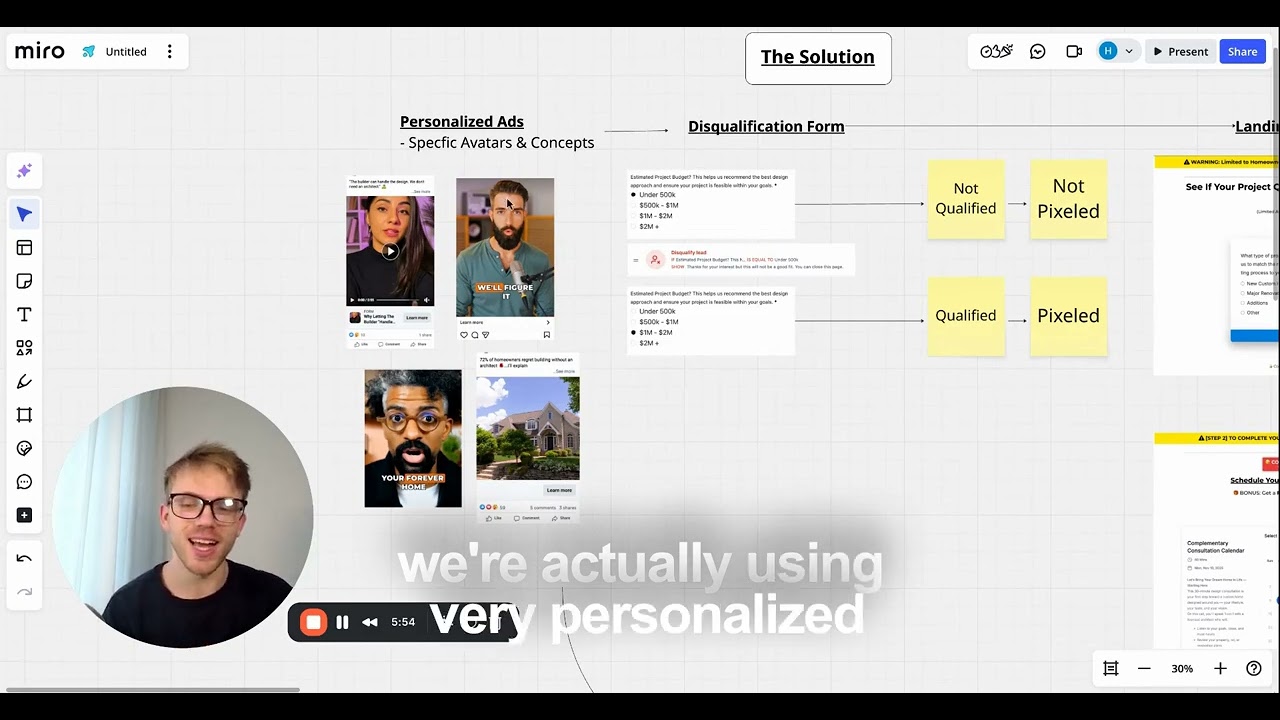
Okay. The first step in actually solving this problem is going to be personalized ads. And and I guarantee you right now, these are all screen swats from our own process, right? So our own um AI uh messenger agent Kong and then we have the CRM and then we have the landing pages and all this good stuff. I'll explain how the whole system works, but this is literally screenshots from our ads and they actually make a difference.
And the reason for that is is if we're actually instead of taking the step towards generic ads, we're actually using very personalized ads, more specifically videos, people that people that can resonate with each other, right? If you look at this headline here, the builder can handle the design.
We don't need an architect. Typically, one of the biggest objections that you'll find as an architect is that they just go with the builder. Things of that nature. This isn't a personalized ad to that specific person that was specific objection that we're trying to handle before they actually come through. And a lot of people like to learn, especially the entrepreneurs, business owners, developers that you guys are after, they're very entrepreneurial minded. And they typically people like that get a lot of dopamine from learning, especially learning things that they
resonate with or that they actively do in terms of career or the money that they make. So when we pretty much put advertising together that's very personalized, very niche to the avatars and concepts, what we're actually doing is we're taking a step back in awareness, right? So instead of the very generic, you know, hey, are you looking for an architect? Well, again, that's a very small portion of the market, very very very small portion. And so we need to go after the the avatars and the ICP
or ideal clients that have problems that need to be solved. So someone that doesn't know they need an architect but they know that they have a problem as in like I need to get this house built or I want to wake up in a house that feels that you know it's more for me or even a commercial project as in like okay I want to grow to this much revenue that means I need these many buildings which means that I need to start building and get them out uh you know growing in that direction well what's it going to start with well proper planning who's going to do that well I don't know right so we
need to get to the people that are problem aware first and then and again if you go to my YouTube if you go back to the channel, you'll see another video that's titled uh, you know, like our strategy to, you know, get high quality leads for architecture. It goes into that exact marketing strategy and explains exactly how to take a step back in awareness and how we actually do that to get better results. So, if you've uh when you finish watching this video, do make sure to go check that one out because that will show you exactly what I'm talking about when it comes to
getting really specific with the avatars and concepts. Okay. So again, we use personalized ads. Ads that resonate with specific types of avatars in a stage back of awareness instead of going after people who already know they need an architect, which those people are typically very small. They are very they're after many other architects.
They're going to come to you say, "Hey, what do you charge? I already got four different quotes, etc., etc. proposals." We want to just get rid of all that and stay away from those types of people. And we want to go after people that don't know the architect, which is a much bigger audience. And I'll just show you how that connects in the future.
again watch the video that I mentioned before that will tell you exactly what I mean here by the that um you know taking a step back in awareness and the importance of that okay it's actually one of the reasons why we probably get the best results in the industry and I don't even say that out of arrogance I say it out of confidence in data it's just because we take it we actually take marketing to the next level especially with new algorithm updates from Facebook the old Facebook and the old strategies do not work anymore and so you have to work with someone who's competent and is
investing themselves literally in programs and things that will help them get more prepared for the new algorithm updates and moving forward getting better getting better right so that's why I told you like this is much more intricate than the more generic stuff that most agencies do and that's because we invest a lot of time into each aspect of the process right so now that we have the personalized ads we have a disqualification form now it's much more intricate intricate than just a form
that says hey do you have money click yes or click no they click no they get off the page they click yes they get on the page The problem with this though is that most people that are pretty skeptical, they will just say, "Hey, I don't have $500,000 to put into a budget just to see where this goes." And the problem with that is some people actually would DQ too soon. People will lie on their form, just to feel safe in this process.
And the problem is that we're probably losing a lot of momentum, not going after the people who say uh under 500K. The problem is though is that we'll cover it later, but most designers don't have time to deal with these types of people, right? these qualified the them especially with the lead flow that comes through. So just to give you an example, we have a qualification form and this is probably the major question, the major DQ question when it comes to finances. Hey, your project budget is it under 500K or is it not? Let's just put it that way, right? If it's equal to 500K, they get
DQed, but not DQed in the way that you think. They get DQed. They still their information still goes to the landing page, but it goes to a different landing page that's not pixel. If you know anything about Facebook, Facebook has pixels. Pixels basically are a bucket that just stores data, right? The more data the pixel has, the better decisions they can make for the ad account, right?
So what who and who gets to see an ad at what time and and what ad do they see? That's what a p pixel solves. But the pixel is only good as its data, right? So we don't want the pixel to collect unqualified data that are under 500k. So when it comes to people that are over 100k in budget or 500k in budget, they're Facebook is absolutely trying to optimize for those. But for the audience that doesn't have or selects under 500k for whatever reason that are just not qualified, it's not pixelled. So the
pixel is not collecting that data, but they still go into our CRM. And what happens is that we are using other forms of infrastructure to help qualify those leads to actually see if they're serious. And I'll just give you an example. We had a lead come through. They put under 500K on the form, but they had a 825K budget, almost a million dollar threshold, right? More or less.
And they're a developer. It's like they click under 500K to feel safe and to keep going through the process. And so if we just DQ DQed him off the bat, we would have never got that lead and never booked them on the calendar. And so that's why when we do it this way, we can basically recoup, make sure that Facebook gets its qualified data 100%.