The Royal Institution · Transcript · · Updated
Colour Mixing: The Mystery of Magenta – Transcript
Video by The Royal Institution · Watch the original on YouTube
Summary
AI-generated from the transcript. Verify details against the source video.
- Human eyes contain red, green, and blue cone cells that are sensitive to different parts of the light spectrum instead of measuring wavelengths directly.
- When both red and green cones fire simultaneously, the human brain perceives yellow light even when no yellow light is present.
- Magenta is invented by the brain when the red and blue cones fire while the green cone does not, which is why it does not appear in the rainbow spectrum.
Use this video with Pro
Reading, copying and transcript downloads are free. Create saved AI results for this video with a signed-in Pro account ($9/month).
Transcript
Search ignores accents. All transcript text stays visible.
Purple is a weird colour. The formal name for purple ismagenta, and the weird thing about magenta is that you won't ever see it in a rainbow. And the rainbow is supposedto be the full spectrum of colours. So why doesn't purple,why doesn't magenta appear in the rainbow?
And the answer is to dowith colour mixing. I've always had a problem withcolour mixing, because I know that you can't mixphotons together. So you can't take a blue photonand a green photon and mix them together to getsome other photon.
That just doesn't happen. And yet, you can mix paintstogether in art. Color mixing is definitelysomething you can do. So what's the answer? Well actually, you can't mixcolors together in physics, but you can do it in biology.
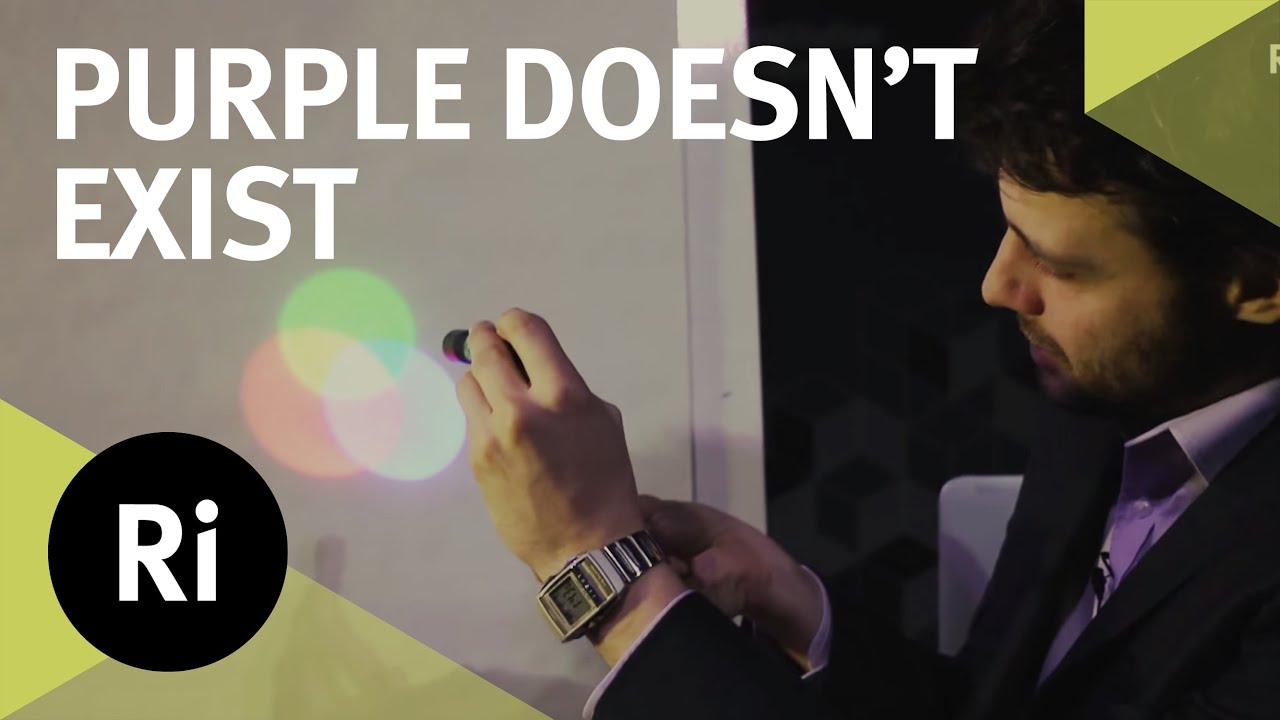
It's to do with howyour eyes work. For example, if I shine redlight and green light into your eyes at the same time, ifI cross these over, you will see yellow. So when you mix red and greentogether, you get yellow.
And if you look at the spectrum,yellow is in between red and green. So maybe that's the rule formixing colours together. You mix two colors together, youget the colour in between on the colour spectrum. And we can test that again,so I'll look at green and blue together. So if I mix green and bluetogether, I get cyan.
And cyan is in between blueand green on the spectrum. So that's great, you mix twocolours together, you get the colour in between. But why, why is that? Well, your eyes can'tmeasure the wavelength of light directly. So it's not like a photon comesin, and you know, it's 200 nanometers or whatever,and it detects that.
Instead, you have these conecells at the back of your eyes that are sensitive to different parts of the spectrum. So when red light comes intoyour eyes, there's a set of cones that fire and tell yourbrain you're looking at something red. So we'd call thosethe red cones.
There's another set of conesthat are more sensitive to green, so when there's greenlight going into your eyes, they fire and they send amessage to your brain. And there's bluecones, as well. So you've got red cones, greencones, and blue cones. So what about yellow? What about when you're lookingat yellow light, like that?
Well in that situation, youdon't have a yellow cone. So what do you do? Well, yellow is quite closeto red, so your red cone fires a bit. And yellow is quite close togreen as well, so your green cone fires a bit. So your brain is getting amessage from your red cone and your green cone at the sametime, and it's deciding, OK well, I must be looking atsomething in between those two colours, then.
And that's brilliant, becauseyour brain is perceiving something about the worldthat it isn't able to measure directly. It isn't directly sensitiveto yellow light. It does mean that youcan be tricked. And so if I make red light andgreen light go into your eyes, but no yellow light, youwill see yellow.
Anyway. So, go red torch and a greentorch, and there's no yellow light, here. But when I combine them, youwill see yellow, anyway. And TVs do this all the time. So if you look up closeat TV, you'll see the individual pixels.
And there are red pixels, greenpixels, and blue pixels. Those are the only colours beingproduced by your TV. And yet, they can produce allthe other colors with this trick of colour mixing. So what about purple? What about magenta? Well, what should your brain doif your red cone fires at one end of the spectrum and yourblue cone fires at the other end of the spectrum, butyour green cone doesn't fire?
Does it do the same trick? Does is think I must be lookingat colour in between red and blue? When the colour between red andblue is green, and you're definitely not looking atsomething green, because your green cone isn't firing. So in that situation, yourbrain invents a colour. It makes up a color, and thatcolour, is magenta.
And I can show you that withmy red and blue torches. So when they're combinedtogether there, you see magenta-- absolutely beautiful. And that's why you don't seemagenta in the spectrum. You don't see magenta in therainbow, because it doesn't have a wavelength.
It's just the absence ofgreen, if you like. Just to show you the fullpalette of colours that you can see on a TV screen-- so you get red and blue mixedtogether makes magenta. Green and red makes yellow. Green and blue make cyan. When you mix them all together,you get white. So when your red cone, yourgreen cone, and your blue cone are firing together, youget white light.