Sam Krones · Transcript · · Updated
How To Write In An Open Tuning (AND WHY YOU SHOULD) – Transcript
Video by Sam Krones · Watch the original on YouTube
Summary
AI-generated from the transcript. Verify details against the source video.
- Sam Cron explains that open tunings are tuned to the intervals of a chosen chord, and every open tuning plays a little differently.
- Sam Cron likes playing in an open E tuning down tuned to a C sharp major chord because it sounds lower and provides a nice contrast with his voice.
- Sam Cron recommends learning other people's songs and understanding the basic major scale in your tuning to improve your riff writing.
Use this video with Pro
Reading, copying and transcript downloads are free. Create saved AI results for this video with a signed-in Pro account ($9/month).
Transcript
Search ignores accents. All transcript text stays visible.
Okay. Hello. If you are new here, hi. My name is Sam Cron. I am a guitarist out of Southern California and I tend to specialize in the whole Midwest emo math rock uh genre side of things. I make videos on the internet that kind of sound like the one that you just heard.
And today I'm here to talk to you a little bit about open tunings. Whether you are kind of just getting started in open tunings, you have no idea what to do or maybe you're just looking for a new train of thought on the whole thing. That's kind of what I'm here to talk to you about today. So, um, to kind of start out, I did want to mention there are like so many open tunings, you can actually make any chord into an open tuning. So, like if you just are playing in standard tuning, you play a chord.
Tune to that chord. You know, tune to the intervals of that chord because that's really what an open tuning is, right? So, if we take a look at some of the most popular ones, I'm putting them somewhere on the screen right now. Those are just the ones that I see primarily in Math Rock, Midwest by Sim Mo. You look at some of the most popular bands in these genres, that's usually what I find. My favorite out of this bunch is this one. It's Open E. I like this one just because of the way that it plays.
And that's one thing I wanted to get into is that every open tuning is going to play a little bit differently. So, if you're trying to use a different open tuning than the one that I'm discussing today, which is the open E, it's going to play a little bit differently, but you can still take some of these aspects and put them into those tunings and try and find your way around it. I can also make different videos especially on those specific tunings. So, if you want to see that kind of stuff, be sure to leave a comment down there, let me know.
Well, cool. Okay, so let's just kind of take a look at this open tuning right now. It sounds like this. Wow. Okay, that's out of tune. Just kidding. Okay, this is what it actually sounds like. Explosion of noise. First of all, it already sounds gorgeous. But you're going to be like, "Wait, pause. That doesn't sound the same thing to me as my open E, which sounds like this."
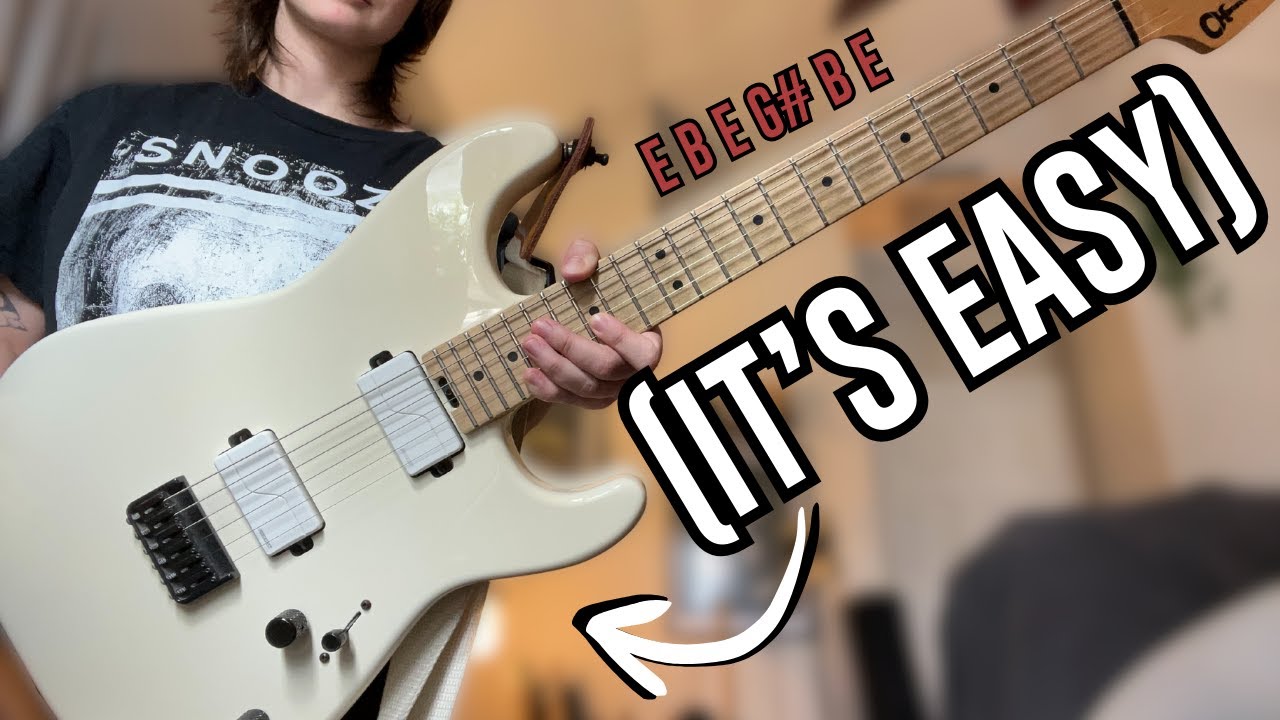
That's because I am down tuned to here. Um, which is actually technically a D flat major chord or a C# major chord, whatever you want to call it. Um, so usually where an open E major chord would be E, B, E, G, B, E. I'm tuned to C#arp, Gsharp, C#, F, Gsharp, C#. That one's a tongue twister.
Anyways, okay. So, this is my tuning. The first step, I think, for anybody in trying to get a little bit more into playing riffs, writing riffs in their genre is make sure your first step you have a good tone. You're probably listening to this one. Sounds pretty good, I think. um personal opinion, but there are a number of factors that go into my tone and what makes it what it is. Um the first one being the pickups that I'm using. The pickups that you're using are very important. A lot of people in the genre tend to use Telecasters because the telly's
generally sound bright. Telly, middle position. That one's always perfect for the genre. I know Jazz Masters, Jaguars are also very good. Um but you can still play these genres on like any guitar. This one in specific has the uh Fishermanfluence Toenabasi pickups. So, they're very like they're active pickups. They handle very well under high gain and they they happen to handle the lower bass frequencies really nicely, which is why I play drop tunings a lot more. The main brains
behind this is Neural DSP's Archetype Pl. That's the plugin that I'm using for all of the tone. You're not hearing anything aside from my direct input into that plugin. So, that's kind of cool. If you like that, go ahead and check them out. This is not sponsored or anything. I just like using their stuff. So now you're probably asking, why am I tuned so low? I like this tuning better specifically because it sounds lower.
You can play chuggier chords that way. It's a little bit more behind it if you're downtuned. And another thing for me particularly is my voice is kind of in a higher register. So when I play over a lower register guitar, it sounds a lot nicer because there's like this contrast in the bassiness and roundness of the guitar with kind of a floaty vocal on top. That's one thing that I love to mess around with when playing. But yeah, to kind of get into it a little bit more, the first way to really get into
an open tune like this one or any open tuning is to learn somebody else's song. You've probably heard this before. You've probably heard somebody say this before, but I genuinely believe that learning other people's music is the quickest way of improving upon something because what you're doing is you're taking somebody else's knowledge and their decisions. You're kind of picking apart why they did some things the way that they did. It starts to open up different opportunities for you. It opens up new techniques. I think it really depends on the genre cuz open
tunings again can be used so many different ways. If you're listening to a Midwest Simo song in an open tuning, it might be Sorry, excuse the birds. Probably gonna sound way different than a map rock song in an open tuning. Same tuning, different styles, right? As we're talking about how to use this tuning tailored to your specific style or your voice or how to get your voice out of this tuning. But yeah, with with the first way being to understand somebody else's song, taking the riff that I showed you at the beginning of
the song, roll it again for like two seconds. If you learned that riff, now you know, sorry, now you know all of the techniques that I was just playing in that riff, especially if you can like slow it down, learn it exactly note fornotee, you now have all of these techniques that are available to you that you can now play with in your own writing. So that's why learning other people's music is so helpful because it allows you to learn their chord voicings as to where something learning somebody else's song and open tuning might get you familiarized with the chord shapes
that are very common in this tuning. So you can start using these chord shapes in your own riffs and in your own melodic phrasing. Now, that actually brings me to my next point, which is instead of learning other people's music, which I recommend you do as well, I think it's a good thing to try and at least know the basic major scale in your tuning and understand where that takes you with chords, cordal motion, because in any open tuning, I generally like to find the chords that I'm playing in so I can understand what kind of progression I'm playing. I used to think for some
reason that not knowing any theory would actually benefit me in writing because it would make it so much more natural when it comes to writing things that I think sounded good. But if you learn theory, it shouldn't really change the way that you write music because the creative brain and the theory brain are two separate things that go hand in hand. The more consciously you understand music theory, the more subconsciously you'll start applying it to your music because you again, you should not be thinking about writing differently. You should be thinking about it the way that you always think
about it. Okay, this sounds good. Where can I take this to make it sound better. Let's take a look at this tuning in specific open tuning. You can actually use this for the open E. It's going to sound a little bit different, but this is the one that I'm using again. Open C# sharp or D flat. This is my major scale, right? We've got 1 2 3 4 5 6 7 1. Now, I'm going to apply this same chord shape
across all of these chords. And I'll describe those after I do it. Here are these notes again with fully stacked chords on top. So, we've got 1 2 3 4 5 6 7 back to one.
Now, let's take a look closer look at that. First thing to notice is that I'm literally just stacking two notes on top of each other on the like fifth string and sixth string. So that's just a power chord because another thing to think about is like interval training in these tunings. If you understand intervals a little bit better, you're going to understand kind of what's happening down here. We take this shape for example.
This is a power chord. Um if you think about it like we're in standard tuning, essentially all you're doing is playing the one of the five, right? But again, not super important. What's really important is actually giving this chord context, right? Because you can play one to five. Just sounds like a power chord. I'm going to go through this very basically first. So, we've got the one to five. I'm going to throw my three on top on the third string, first fret.
So, that's a minor two. Right? Now, I'm going to take the same shape. We're going to move it up to the minor three. Because we're playing a minor three, the shape is going to stay the same, but we're just going to move it up two frets to that three. Right? Now, here's where it gets a little bit different. Um, we now move this shape up to the four chord next. But the four chord in a major scale is major. So, we're going to have to raise that three a half
step to make it major. Right? So, these two notes stay the same. This note changes. So, we're going to move it up. Move that up a half step. So, instead of playing a minor four, right, because that sounds kind of ugly in this context, we're going to move it up. Play a major four.
Right. Same thing. Um, we're going to go up a whole step again to make this into a five. Then we're going to do the same thing again, except it's going to be minor because it's a minor 6. We're going to do this one more time.
Um, we're going to turn it into a diminish chord, which would sound like this. And then we're going to make it back to one. Just like that. Okay. I'm out of tune again. Now that we've kind of gotten over like chord shapes, you're going to be like, "This sounds pretty basic."
Which you are correct. Um, and if we remember, we are using an open tuning so we can use the open strings. That's the whole point of tuning to an open tuning in the first place. It's so you don't have to stretch to make these crazy inversion shapes just to get something some melody to sound good. You can use the open strings to your advantage. So, here's an example of that in the same circumstance that I was just talking about. If you have just the open chord, I'm now starting to introduce the other open strings with these same chord
shapes. So, check this out. If I just strum it through, sounds pretty cool, right? So, all I'm doing there is I'm going through a major scale and I'm using those chord shapes.
But what I'm now doing is these extra strings are kind of acting like pedal tones. So when I play them, these notes are staying the same, which gives it this very dreamy like feel because all of the chords, even though the chords are changing, there are some notes that still sound the same, which gives it this very dreamy like airy feeling, right? That's why we use open tunings is to achieve this sound without having to bend to some crazy shape. So for a circumstance like this, it actually makes it easier to do things
technique-based because you have more freedom, more fingers, more capability to pull off to open strings, all of that fun stuff. So, you know, whereas usually in standard tuning where you would have to deal with more inversions, here you can focus more on technique- based stuff and still have like a coherent melody, I think by far open tunings are the best spot to work on technique. And the reason for that is because you're not so stomped up with theory. you're not so
sumped up with understanding things, as long as you have a chord shape, you can use hammer ons and pull-offs to your advantage to make something sound a little bit more unique than you would have in like standard tuning or something. So, for something like this, I'm going to give you an example of another riff that I wrote not too long ago and let's break it down. Okay, so this is that riff.
So if we just look at that riff for example, I'm using more techniques in this tuning than I usually would in standard tuning. Right? So the first thing is tapping. Anywhere that you tap on the 12th fret, granted if you're in the key of the open tuning that you're in, this for me being C# or D flat, everything that I tap on that 12th fret is going to be in key. Every single thing, right? Because there are only so many notes on that 12th fret, and
they're all in the tuning. So for something like this, that already sounds unique. I'm involving hammer ons onto these chords because it's only two, three fingers, that's the only thing that matters. I hammer that on, then I tap.