Passions Urbaines · Transcript · · Updated
Cerdà ou la naissance de la discipline "Urbanisme" – Transcript
Video by Passions Urbaines · Watch the original on YouTube
Summary
AI-generated from the transcript. Verify details against the source video.
- Serta is considered the creator of the discipline of urban planning because he was both a theoretician and a practitioner who tested his theories on Barcelona.
- The Barcelona extension plan of 1859 involved competing proposals from Rovira, who proposed a radio concentric extension favoring the bourgeoisie, and Serta, whose plan had a more social and egalitarian vision.
- Serta authored the book General Theory of Urbanization and invented the term urbanization, which covered urbanizing, population concentration, and urban planning as a discipline.
Use this video with Pro
Reading, copying and transcript downloads are free. Create saved AI results for this video with a signed-in Pro account ($9/month).
Transcript
Search ignores accents. All transcript text stays visible.
history and urban theory, the industrial revolution and the birth of urban planning. First of all, let's talk about even Serta, who lived between 1815 and 1876. He is considered the creator of the discipline of urban planning.
There are no other contenders for the position of creator of urban planning because he was, in every way, the creator of the discipline. There is no competitor or anyone who claims to have created urban planning before Serta because the advantage he has is that he was both a theoretician and a practitioner.
And he tested his theories on a city, which is Barcelona. He is a civil engineer from the Madrid School. So he studied in the Spanish capital and that would have an impact on his career later on. The Barcelona plan of 1859, so all over Europe, at the beginning of the industrial revolution, the city walls or enclosures fell one after the other and the city had to be expanded.
There was a strong migration from rural areas to the city and the city walls were no longer useful. The technology that was achieved during the industrial revolution was such that the city walls were no longer a viable defensive system.
So it went away, it was no longer necessary to rebuild a new wall. Barcelona experienced the same thing as other European capitals or cities, so the city walls were demolished. The city expanded, and this was due to the pressure on land linked to the development of the city and the effects of the industrial revolution.
The Spanish government entrusted Serta with the city expansion plan. Serta, having studied in Madrid, many of his classmates or friends who had been with him at the moment, who had been with him at the Madrid School of Civil Engineering ended up in the ministry, in several ministries at the central government level, and that's what helped him receive the commission to create the extension of the city of Barcelona.
At the same time, the city of Barcelona. Since let's not forget that Spain is a federation, so there is a Catalan government and the city of Barcelona entrusted the same work to a Catalan architect.
And this architect had won an architectural competition. So there was a competition, Rovira, and the first one to arrive, and then we have the two plans, Rira's plan against CDA's plan.
So Rovira's plan, uh, would say that it's more time that makes the city and not the architect. He proposed a radio concentric extension. You can clearly see old Barcelona at the bottom in the middle and then he extended the city's axes in a radio concentric form.
He didn't use all of the area around the city of old Barcelona. He used a limited part in his goal, he didn't hide it, was to favor the bourgeoisie much more while the city was experiencing rapid expansion due to the workforce that was moving into the city.
So the idea was to expand the city and extend it mainly in relation to its bourgeois population. By the way, he said, The exact text, I don't remember it very well, but he spoke of a city that was much more intended for people who were not workers or proletarians who could no longer live in the city.
So the city had to develop in relation to a certain segment of the population and he used a certain number of architectural elements such as the axes that emerged from the city center, the creation of a certain number of squares and so on.
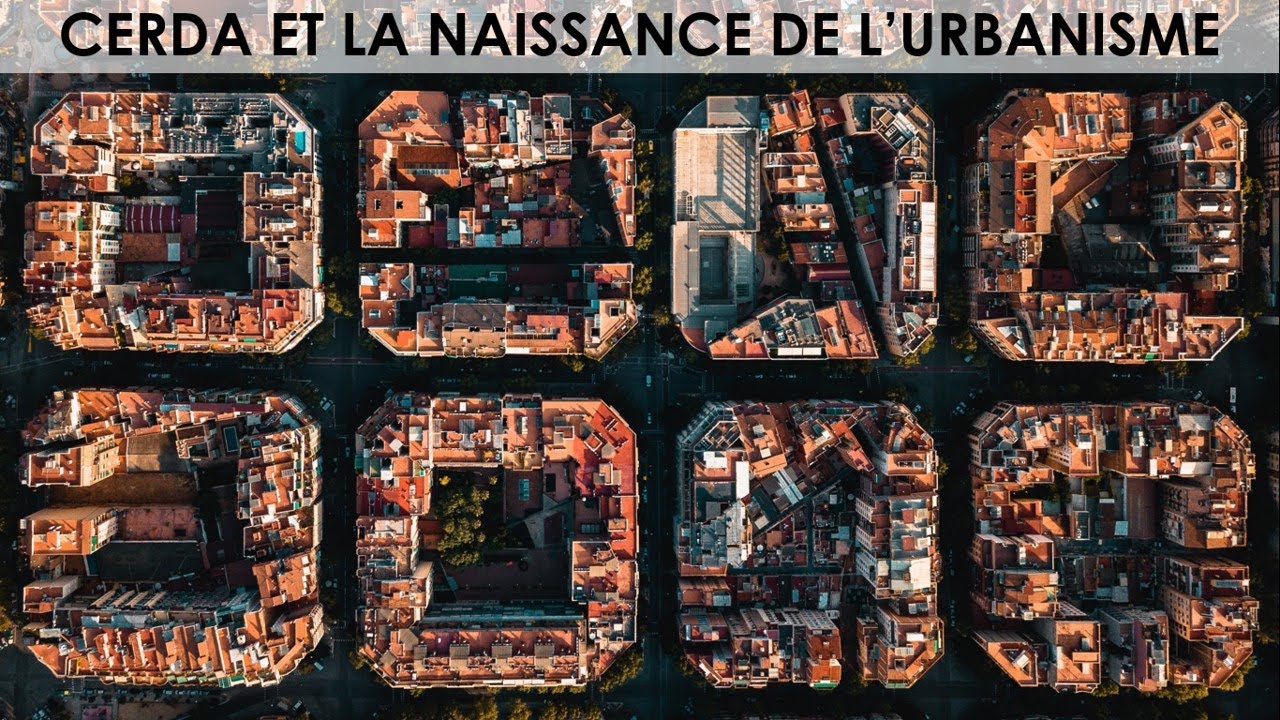
Serda, on the other hand, had a much more social vision. Serda said that the city had to be for everyone, for the workers, for the rich. And instead he developed a Barcelona in which the old Barcelona was included.
Rovira created an extension from the old Barcelona. Serda created a new Barcelona in which he included the old neighborhood. And you can see this in relation to Serda's plan on the right, the plan where the surface area used is much larger.
It's not just a question of scale. It's not because the plan on the left is a little more detailed and we've zoomed in a little that the Plans aren't comparable. If you take the two plans on the same scale, it is clear that Rovira did not use the entire extension, whereas Serda used all the space that was planned, all the brownfield land that was available around the city, and used it.
And we can clearly see that in both plans, the similarity is that old Barcelona, through the continuity of its axes, is a concern for both, both in Rovira and Serda. Finally, Serda 9's plan was imposed by Royal Decree, Serda's proposal.
So the game between the Catalan government and the Spanish government was cut. And that, by the way, earned Serda a lot of criticism because he had the support of Madrid. In a way, it is a game between the Catalan and central government forces of influence.
It was very badly perceived in Barcelona. But Serda's plan had many aspects and many novelties. When he saw the city from the perspective of a road and bridge engineer, from the perspective of a civil engineer, he could clearly see that the city was going to grow and that motorization would be the driving force behind the city's organization.
That wasn't reflected in Rovira's plan. What were the objectives of the Barcelona 58 plan? Firstly, the desire for hygiene. The traditional city was congested. There were a lot of diseases and very little sunlight or air got in.
So, Serda proposed to expand, to create boulevards or streets measuring 20, 30 and 60 meters in the city of Barcelona, according to Serda's plan. To take charge of increasing mobility. So, given his profession, Serda was very aware of the importance of the car and the various sewer and sanitation networks, etc.
So, he was, let's say, a visionary in terms of the city's progress. He used a principle that was, let's say, that of restructuring of legally innovative reparsaling. At the time, we needed large islands, we had three small plots and well, we were going to connect them.
We were going to recover them and build. We were going to consider that the plots of land were not a blockage. Legally, we were going to acquire them, we were going to re-divide them and reparsal them. Finally, unlike Rovira, he had a much more egalitarian inspiration.
Facilities for all that affected the general interest. Moreover, the hippodamian network that he set up allowed for better accessibility. Wherever you are in the city to go to any other point, the hippodamian network is the one that best allows for fluid movement between points in the city.
So, he was also the creator of the concept of urban planning. Serda, in his book General Theory of Urbanization, because he was the author of a very interesting book, Paris in 67. He talked about several elements and he invented the term urbanization.
So the word urbanization or the term urbanization, he dealt with it in his book which was in two volumes. The first is urbanization as a concrete fact, so the theoretical aspect and the second is the urban statistics of Barcelona. What does his work contain?
Firstly, the method he uses in his work is organized in relation to several elements. Firstly, the analysis of the city is a real work of anatomy, an anatomical dissection, a study of urban organization. As we can see today, many have been inspired by this way of doing things.
Today we talk about urban fabric, urban cottage. So, there is a lot of terminology that comes from this study of the city as if it were a body that had to be dissected. Secondly, Serda isolates the spatial container from the social content.
The city is a two-sided piece, a fact comparable to the layers of geological formation in which there are several overlapping histories in the city, and the city itself is made up of two parts, a physical aspect, the city, a social aspect, the society that inhabits it.
Finally, he uses a historical method to study the evolution of the urban area. So to study the evolution, we will try to look in history for the different important urban events and their impact on the city. And secondly, we try to use a descriptive method in relation to the urban organism when we try to analyze it.
The word urbanization in his work is described as a set of actions tending to group buildings and regulate their functioning. So, there is a search for ordering as a set of principles, doctrines and rules, therefore the principles of urban planning that must be applied to buildings and their grouping.