Munro Live · Transcript · · Updated
Tesla Cybercab Deep Dive: Inside the Engineering with Lars Moravy and Team – Transcript
Video by Munro Live · Watch the original on YouTube
Summary
AI-generated from the transcript. Verify details against the source video.
- Lars Moravy and the Tesla team explain that the Cyber Cab uses an unboxed vehicle architecture with smaller modules and 25 fully automated final assembly stations.
- Robbie and the Tesla battery team describe the Cyber Cab battery pack as a semi-structural design utilizing a steel top cover and wireless communications.
- Jutna and the Tesla plastics team explain that reaction injection molding with robotic trimming is used to make exterior plastic panels and eliminate the paint shop.
Use this video with Pro
Reading, copying and transcript downloads are free. Create saved AI results for this video with a signed-in Pro account ($9/month).
Transcript
Search ignores accents. All transcript text stays visible.
>> >> Heat. Heat. Hi everyone. Welcome to Monro Live.
We've got an exciting uh series or episode that we're going to stitch together here. I'm with uh Lars, Eric, and Hector. Um all from the Tesla team. I'm sure you know these guys behind us. Obviously, we've got the the Cyber Cab.
So, we're going to dive into the unboxing. We're going to walk a bit of the line. We're going to look at batteries, but it's going to be exciting. I don't know if it's going to be more exciting than the Roadster video from >> Wrong hat. I wore the wrong hat. Everyone's got a cyber hat.
>> We got to swap hats. But uh so I mean let's let's dive into what we're seeing on the floor here. Like what was what was the design intent like the the whole unboxing discussion came out a while ago? >> It did. I think we first kind of it's it was probably like five or six years ago.
Yeah, >> we were working on like automating our lines more and more and more >> and we kind of hit a wall where like the problem wasn't the automation, the problem was the design. And you know, my team is responsible for not just the design of the vehicle, not just the test of the vehicle, but also the manufacturing and even the automation groups that we have within our our team.
They're all in one engineering org. So, we got a few of us together and we're like, how are we going to break this? And like that was the answer. we had to break it apart and um you know Eric at that time was in charge of our integration team and that was a big task of like a hundred years of building cars one way uh how do you break it apart and so we kind of looked at a car and realized it was a box you know there's like a bottom a top a left a right a
front and a back and then we came up with the idea to unbox it and really that did two things for us uh fundamentally one it gave us smaller pieces to work with So we could get robots in tighter and we'll walk through each bit um a little bit. And then two, it also allowed us to break the line apart and go to more like a tributary and main flow. And so you know the manufacturing guys like like Hector works with they're able to make final line. How many stations is like 25
stations? >> 25 stations fully automated. >> Like final GA when the whole thing comes together is 25. >> Wow. And like a normal Model Y was probably like 5 10x that. Yeah. >> Depending on which factory and how much you're running. So >> those are the two big things. But why don't we start like piece by piece. Eric and I can give you a quick review and then Hector will just tell you how we put it all together.
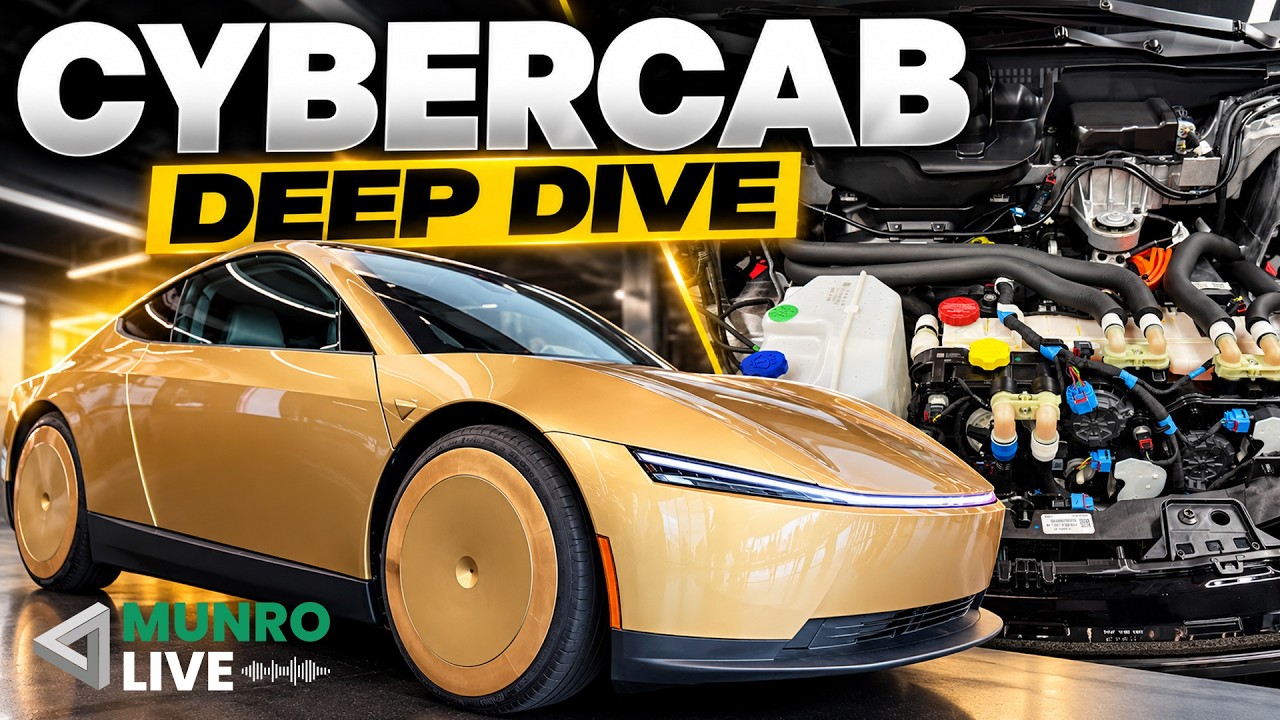
>> Yeah. Yeah. Great. >> Why don't we start up front, Eric? >> So the front Yeah. The front is one of the more uh obviously dense and integrated modules that we have. >> This is the business unit. >> This Yeah, exactly. This is basically where you know 50% of the parts and the content really is at. And we did that on purpose. We wanted to have everything isolated to one area for efficiency of low voltage distribution. We put all of
the end points, all the electronics where the control systems are. And so that's kind of what we've done here. And we've also revolutionized, which we'll talk about a little bit later, how we do thermal system management. Moving, you know, another step uh from our super manifold of previous products. We've got a 48volt low voltage battery. Uh and then on top of that, we've got the drive unit which is basically right in here in the center. And one thing that we heard
a lot from our service teams really early on in this project is we wanted to make the drive inverter serviceable without having to basically tear the car from the underside out. >> Yeah. >> And so what we've been able to do is allow this assembly to be very simple to remove. Obviously the washer valve is very simple to remove. It allows you access to the inverter. So we don't even need to raise the car, tear the suspension, tear the drive unit out to service the inverter. And so the fundamental aspect of integration here is is is principally insane.
>> Yeah. >> Like it it really is. >> And you can't like do that without thinking at the beginning cuz Eric just very casually said, "Oh, we just take out the thermal system." >> But it's a refrigerant system, right? You can't break refrigerant lines, >> right? >> So we actually flipped it. It's a coolant based system for heat exchange.
and the refrigerant systems completely closed. >> It's a closed loop system within the >> which you couldn't worry about after the fact to your point, >> right? You had to do it at the beginning and so like it went all the way back to it beginning of design and then you know to to drain and purge a coolant system is actually pretty easy.
>> Yeah. >> And we even on that we actually made a through loop so you can push and pull and do it faster. >> Oh, that's brilliant. Suck it out. >> The the things that really stand out to me, I mean we've obviously torn down a bunch of the other Teslas. It's it's the packaging and how tight the the drive unit is in Z. Like it's way higher in Z relative to the super beam. And actually, you know, is so what is mounted here? Is this the EAC compressor?
>> This is the AC compressor and >> basically the the coolant manifold and the coolant controller all one assembly. >> It's all integrated together. >> And that's goes back to the principle of integration and test. We talked about that tributary flow. Everything is self tested before it goes in. So when Hector is building it, he knows he has a good part, right? And so we have a, you know, a module line that builds the integrated thermal or the indirect thermal system and that's then self- tested on the line. So we know we have a good part
coming in and you'll kind of see this like every part comes together. Same with the drive unit. And then by the time we get here, you have the full front end that Eric was describing with all of this. We actually know the car is ready to drive and go and all the all of the computers are hooked up when the front end uh comes to line. So it's pretty cool. But we really took a lot of the principle of moving moving complexity out and building modules that
bring assembly upstream so we can self test more in larger modules as well as uh in in in sub subasssemblies in a much higher percentage than anything we've ever done before. The other thing I I guess I'll say on the integration side which I know you're you're keen on is like this has been the core you're >> keen on it too.
>> I am keen on it as well. the I this is a core of Tesla, right? Is an organizational structure of engineering that works really well together. There is no there's no like veil. There's no wall between teams. And that's kind of what you see here.
>> No ego either. >> There's no ego either. >> Well, I think Lars and I were actually, you know, talking on the ride over here. We were talking about the patents, the designs, you know, what what is the secret sauce to Tesla? And I think you said something like, well, it's actually not that secret. A lot of it's pretty public. And I'm like, I think the secret's the culture. I think it's what you just touched on. I think it's this mindset that, yeah, it's not super hierarchical.
>> It's our problem. >> It's it's it's our problem. It's not your problem because you're the thermal guy or you're the chassis guy or whatever. And and this is the net result. And by the way, I think this is the first example that I've seen from Tesla where the EAC compressor is PIA or part of the assemble.
>> No separate bracket. You know, >> sometimes un unintended consequences. >> Yeah. Yeah, >> like we actually, you know, we put all together, we're like, "Oh man, this this is way like heavier than we anticipated." And we had to like refigure out how to isolate it because it actually added to the, you know, the the modal mapping in the front where normally when it's sort of just a tiny little compressor, it's not that big of a deal.
>> But now it's this big. >> Well, there there's there's some like really cool stuff here, right? Like we are no longer running high voltage distribution from the battery pack to the system. We basically do a junction off of the drive inverter to power. >> That's right.
>> Ah, there's another Conway law break, right? Like >> so now the inverter team is working to make the cost of the high voltage system and the uh the thermal system less means less parts, less complexity. Uh you can ask questions that then I'll go to the next one.
>> So So the inverter kind of became like this little substation like a power distribution a PDC to go and power everything else. So you're not running dedicated circuits all the way from the battery pack. >> And that is that is like 100% the core of this car is like do not waste a gram.
Do not waste anything. >> Yeah. Yeah. Yeah. Yeah. Oh, it's amazing. Okay, >> come around here. Like let's look at the suspension real quick cuz we got a lot to talk about. >> So it's a it's a strut suspension, which you wouldn't think with the low hood.
So, we had to offset the, you know, the the kingpin to be in front of the um, you know, the the center of the wheel there. And, uh, we'll talk about this a little bit more later, too, but it's also our first uh, break by wire system.
And again, that was done because it was almost a necessity for breaking it apart. It's you can't have a closed hydraulic system for braking >> if you're going to split the car into pieces. And so, we can self test the front brakes and the rear brakes separately.
>> Well, this is beautiful, right? because we no longer need hydraulics running from the back to the front from from a booster or from some kind of junction. It's basically everything is isolated to the module that it's in. And it just again allows for us to to take cost out of the distribution of whether it's conductor material or fluids or whatever it is and allows us to simplify manufacturing substantially. So, so it's allowing you, if I heard what you said correctly, you're doing testing like on
the thermal management system by itself and then you're able to plug all these components, brakes, drive unit, all that into the the module, this unboxed chunk, and then you can test it in this state to ensure before it gets bolted to the rest of the modules >> that this is ready to go.