Journey to the Microcosmos · Transcript · · Updated
Flinching Saves Lives in the Microcosmos – Transcript
Video by Journey to the Microcosmos · Watch the original on YouTube
Summary
AI-generated from the transcript. Verify details against the source video.
- Spirostomum, vorticella, and stenters rapidly contract to fractions of their original length in milliseconds when responding to stimuli or predators.
- Mechanical stimulation causes these cells to allow calcium ions into the cell, which rapidly changes the shape of their internal structures.
- Calcium ions must be slowly and carefully pumped out of the cytoplasm for the organisms to return to their original shape.
Use this video with Pro
Reading, copying and transcript downloads are free. Create saved AI results for this video with a signed-in Pro account ($9/month).
Transcript
Search ignores accents. All transcript text stays visible.
this episode is sponsored by morningbrew morningbrew is a free daily newsletter that gets you up to speed on business news in just five minutes click the link in the description to subscribe now when it comes to moving ciliates are spectacular to watch
they're hair-like cilia beat in waves that steer them around the micro cosmos and that's great if you're trying to get from point a to point b but sometimes you're not actually trying to get anywhere you're just trying to be slightly less in the spot you are currently in like these spirostomum which can grow several millimeters in length that size can be an advantage when they're looking for food or
navigating the world around them but it also makes them easy targets for predators same for the vorticella which anchor themselves to substrates and then extend their feeding heads out into the microcosmos it makes them kind of like fishermen waiting for food to come by but it also makes them sitting ducks for predators but spirostomum vorticella and many other ciliates do have a way of defending themselves from these attacks
contracting contracting is like very very effective flinching if you accidentally touch a hot burner on the stove you flinch and pull your hand away very quickly now imagine if you could not only pull your hand back but you could actually shrink your hand down into your arm to minimize the threat of the stove even further well the microcosmos does not have stoves though i guess it could be said
that stoves have a microcosmos but that's a story for a different day instead microbes are caught up in a great game of marco polo with predators responding to chemical and physical cues to detect possible threats and responding in their own ways of course there's the tried and true chemical defense which spirostimum do use scientists have documented a predator vomiting up aspirostomum whose toxins
didn't digest very well but while toxins are a good defensive option to have if you're a spirostomum or any other ciliate you probably don't want to get to the point where you need to be vomited up plus even if you've managed to evade the same predator again and again like spirostomum has there's plenty of other obstacles to avoid the microcosmos
like poop i mean yeah when you have video of spirostum getting pooped on you have to use it anyway whether you are avoiding predators or their poop contracting is a good response to have and these contractions are marvelous they are some of the fastest things in nature and not only do the contractions happen quickly but the time between when the stimulus
is received and the contraction begins is faster than any action you have ever taken scientists have been observing and documenting different ciliates and their contractile behaviors for decades now and it's not hard to understand their fascination for one the contraction looks a bit
like the movement of our own muscles just much faster now it turns out it works much differently and it's also easy to get a cilia to contract and that turns out to be an important thing when you want to study something stenters have been a popular contractile ciliate model because all you have to do to get them from their distinctive trumpet shape to a sphere is pokemon with a glass needle now it's important to note here that we're using this word contraction
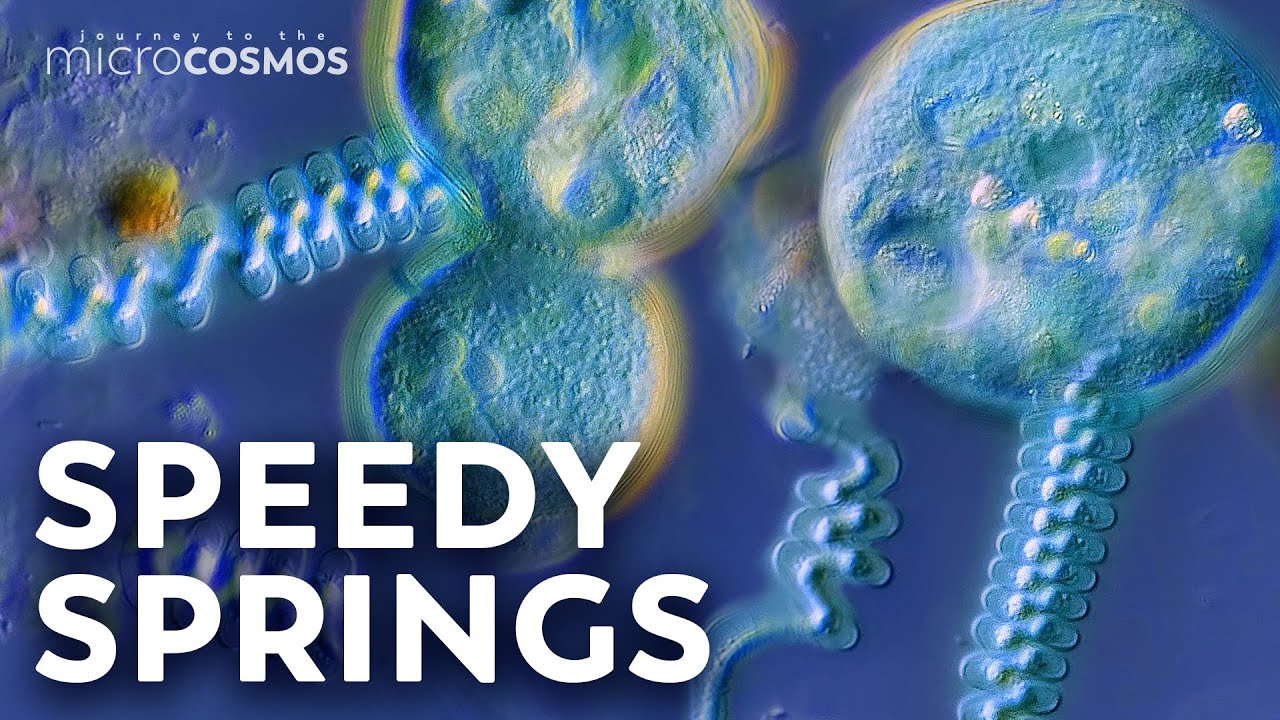
like it's a uniform behavior done in the same way in all ciliates but just like how animals have a lot of different ways to run around ciliates have a lot of different ways to contract vorticella for example don't contract their whole bodies they spiralize their stalks which coil them towards whatever they're attached to and away from whatever stimuli has set them off and spirostomum have their own twist a
literal one specialized membrane structures and the long coil of microtubules spin their ends while keeping their middle stable to activate a contraction in an ultra-fast movement that was only really deeply understood in 2019 now again whatever the change is for the organism though one of the things that these species share in common is that the contractions are very very fast so much so that it's taken
high-speed cinematography for scientists to start to figure out how it works stenters burrostimum and vorticella all condensed to fractions of their original length in a matter of milliseconds a contracting spirostomum can experience forces of around 14g for comparison an elite fighter pilot does not ever experience more than nine g's of force and for vorticella the rapid contraction of their stock
moves them at about 1200 body lengths per second that is very fast that's the equivalent of a cheetah running a mile in a second now interestingly while the organisms we're highlighting today work on the scale of milliseconds to contract they are much slower on the recovery taking more on the order of seconds to extend back to their original state now this makes sense as the goal is to do whatever possible
to escape being eaten so the initial quick movement is more important than the return to our normal activities movement but the factors driving this fast contraction and slow relaxation are both physical and chemical physically the bodies of these organisms contain a mix of contractile fibers that work together and against each other to create these movements in stenters and spirostomum you can see
these special membrane structures running along their bodies and in the vorticella stock you can see this helical contracting organelle called the spasmoneme whatever these things look like you can think of any of these movements not as sudden contractions of muscle fibers but instead as chemicals that change shape in different chemical conditions if the solution they are in
has a bunch of calcium ions the structures are small and tightly coiled if the solution has a low concentration of calcium ions they stretch out and so in all of these cases mechanical stimulation causes these cells to suddenly and rapidly allow calcium ions into the cell which causes all these structures to dramatically and rapidly change shape
but in order to return to the original shape the calcium ions have to be slowly and carefully pumped out of the cytoplasm so calcium ions are used across all of biology to carry information and cause changes in all kinds of biological systems including the biological system that is you but this reliance on calcium ions
is kind of strange it's very common but the evolution of these systems relying on calcium is a little weird because calcium ions can interfere with reactions that are key to our cellular metabolism one recent theory to try and reconcile this contradiction is that the rapid calcium-driven responses we are looking at right now are part of a much longer evolutionary arc
one built on the need for ancient cells to repair damage to their membranes in order to prevent a fatal influx of calcium ions from their surroundings the same urgency that could have driven the evolution of this biological first aid kit might have then been rewired for other rapid sensors and if this theory is correct it means that nature converted a defense against a chemical
into a signaling mechanism that drives everything from the contractions you are watching to the action potentials that are helping you understand the words that you are hearing right now thank you for coming on this journey with us as we explore the unseen world that surrounds us we would also like to thank morningbrew again for sponsoring this episode of journey to the micro cosmos
do you like to begin your mornings by aimlessly scrolling social media trying to find all the news that you may have missed while you were sleeping and never really sure whether you're getting it and oftentimes finding stuff that you don't actually need to be looking at but looking at it anyway and then just not feeling better afterward well i know that i do with their daily newsletter morning brew is here to bring you witty relevant and informative business news all in one
place and they make it easy for you to get up to speed in just five minutes the newsletter is written to be accessible and include all of the need to know information to get your day started like they recently had a newsletter feature that condensed the key takeaways from the iea's latest report on reaching net zero emissions by 2050 and the milestones that governments will need to hit to make that goal achievable if you're interested in business finance or tech there's no reason
not to subscribe to morning brew it's completely free and it takes less than 15 seconds to subscribe click the link in the description below to subscribe to morningbrew the people you're seeing on the screen right now they are our patrons on patreon they're the reason that we can make this show so thank you so much to all of them and normally this is the part where we'd tell you to check out our master of microscopes
james weiss's instagram jam and germs but right now instead we want to make sure that we tell you that tomorrow as of the day this video is going live james's book the hidden beauty of the microscopic world will be out and available wherever books are sold we're so happy and excited for james it's a beautiful thing there's a link in the description and if you want to see more from us