Blue Sense Digital · Transcript · · Updated
Meta Ads Creative Strategy in 2026: The Full System – Transcript
Video by Blue Sense Digital · Watch the original on YouTube
Summary
AI-generated from the transcript. Verify details against the source video.
- Creative is the primary lever in Meta ads because media buying arbitrage has compressed over time as targeting became fully automated.
- The Andromeda algorithm update uses Meta training chips to optimize ad serving without requiring manual interest targeting.
- Regional matching ensures creative performance because native regional accents always outperform translated ones.
Use this video with Pro
Reading, copying and transcript downloads are free. Create saved AI results for this video with a signed-in Pro account ($9/month).
Transcript
Search ignores accents. All transcript text stays visible.
In 2026 and 2027, creative is the lever that sits within Meta ads. Media buying fundamentally is not your advantage right now. You need to become incredibly good at creative strategy, at creative design, production, then moving that into the ad account, and analyzing the creative to create this flywheel effect.
By the end of this video, you'll know everything you need to know about creative for 2026. We're going to be running through why creative is the growth lever, how Meta's algorithm actually works in 2026, concept architecture, hook strategies that actually scale, all the formats you can use and test, a testing framework to take that creative and actually put it into the account to get statistically relevant results. We're then going to move into creative volume, creative diversity, and a financial model that ties it all together. We're going to
talk about fatigue, scaling winners, portfolio management, creative production, so what do the teams, the briefing, and the process look like? And then lastly, we'll tie all of it together and package it into the 2026 playbook. So with that being said, diving into section number one, we have why creative is the growth lever. I've been media buying on Facebook since 2018. So I've been about eight coming up on nine years in the Meta Ads Manager.
And I remember back in 2018, 2019, 2020, there was so much leverage in media buying. You actually didn't need to be very good at creative, and as long as you had a massive edge on media buying, you could beat a lot of people. And the reason for that is that there was a massive skill gap. In fact, I would argue that any arbitrage opportunity that exists within a market is a product of the skill gap that exists at that point in time. So, back then, the difference between someone that just goes and opens up the ad manager and
someone that is a super advanced media buyer that spends 12 hours a day doing this and that's three years in, there was such an enormous difference that that difference allows for arbitrage and allowed for the opportunity. Now, over time, Meta has slowly compressed media buying. The targeting is now fully automated. I would recommend 99% of people are just running broad only, so there's no skill within interest targeting. Andromeda now optimizes for the distribution of the creative.
Consolidation is always favored across all of these digital platforms now because conversion data consolidates, which allows for better machine learning modeling. And all of the media buying hacks that used to exist, like duplicating ad sets or using bidding models in a certain way, none of them really work that well anymore. None of them really give you a big arbitrage.
And so because of that, this arbitrage opportunity has compressed. And instead, where the big arbitrage opportunity exists right now, is in creative. And it is because most people, fortunately for you, are terrible at creative. And so because of that, there is this huge opportunity that if you simply become good at creative strategy, at understanding what a good ad looks like, and then being able to build a system that can churn out a ton of high-quality ads, this is where you now make all the
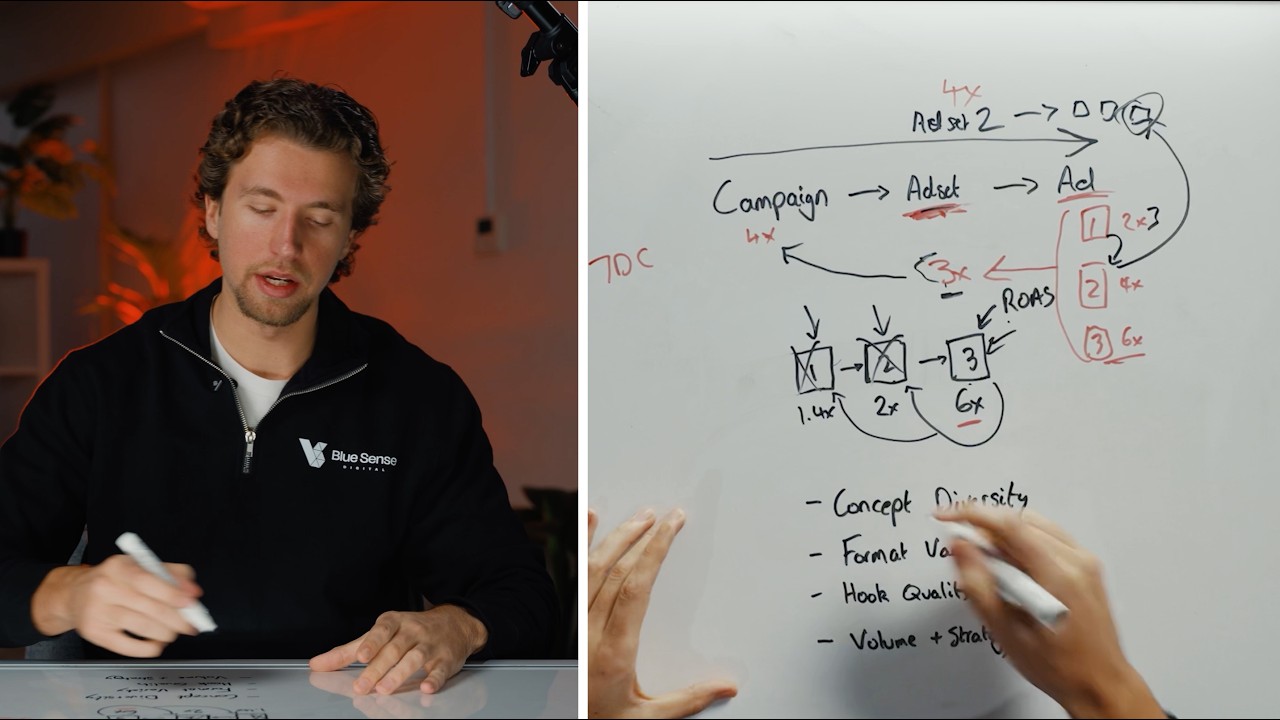
money on that. And by the end of this video, you should unlock this opportunity. So, the first thing I want you thinking through here is the portfolio model. So, let's say that you have $1,000 a day in ad spend, and there is two different scenarios here.
Scenario one is you have one single creative that's holding that entire $1,000 per day, and you're at a 4x ROAS. And then you have another pathway that you could choose. You've got three ads holding $1,000 a day together, and this is also at a 4x ROAS blended across these three creatives.
Now, I would rather be in this situation every single day of the week. And the reason being is that this situation decreases risk enormously within the business, because any of these three creative can fatigue, and the other ones will pick up the slack, and you can continue operating at this efficiency, at this ad spend.
>> [snorts] >> But over here, if this creative fatigues, you're done. And I say this out of PTSD, working with probably eight to 10 clients now over the course of the last six years who have come to us 40% down year-on-year in new customer acquisition. Their business is in a terrible spot and they're going, "Our business is declining. It's because we built this eight-figure business off three creatives that held a million dollars in ad spend and now these three creatives are all fatiguing and we're
trying to spin up variants and it's kind of keeping us at some reasonable level, but we just can't get back to the level and we keep declining." And my response these days is, "It's too late. We're not taking on that account because you should have fixed that six to eight months ago." What people will do is they will get one or two winning ads that can hold a tremendous amount of ad spend.
And then what they do is they just stop making more ads and they go, "Like, why would we spend money on creative production? That's useless. Let's just double down and put all our ad spend here and then focus on other areas of the business." Yeah, amazing until these creatives fatigue. And the only reality of creatives in Meta ads is that every single creative will fatigue. Every single creative has a maximum spend threshold that it will reach. And so you want to be constantly thinking through creative production ad account management and creative through the lens
of this portfolio model, which is that we want to get as many ads as possible holding as much spend as possible. We do not want to over leverage into one or two ads because this is ultimately what ends up destroying a lot of businesses. Let me give you three common mistakes that most teams are making when it comes to creative. Number one is a lot of people confuse activity for strategy.
I'll give you an example of this, which is recently in the last few months I've seen two ad accounts that are launching 2,000 plus new ads a month and they're barely able to crack quarter million dollars in ad spend per month. Now, for those that work on large ad accounts, you would know that that is insane. You do not need two to 3,000 new ads a month on a quarter million dollar budget.
That's so much volume. And they weren't profitable. And so you're looking at the fact that they're launching so much volume, they're not profitable, They're doing so much activity, but there's clearly a gap in strategy. Because if you were putting 2,000 great creative into the account with a good offer, with a good persona, with a good angle, then you shouldn't need anywhere near 2,000 ads a month. And so yes, I think volume's good. I think you should be launching as many ads as humanly
possible, but with a standard of quality and with a strategy behind the creative that's actually going into the account. So do not mistake activity for strategy. This is really common right now because people think they can just launch more ads and their brand will scale. In fact, I hear this all the time, which is people are like, "Okay, I need to double my business. Do I just launch 40 more ads a month?"
I was like, "If it's that simple, everyone would do it. There's a little bit more to just increasing activity." The second one is misdiagnosing bottlenecks. So with in creative, there is a ton of different bottlenecks that exist that could be holding you back. It could be the quality of the creative. It could be the format diversification. It could be the quantity that's sitting at the different stages of awareness or the stages of the funnel. So you have nowhere near enough top of funnel assets to produce the scale that you actually want.
This might be a bottleneck on not actually introducing partnership ads or employing different strategies into the ad account to unlock more spend. There's so many different bottlenecks that exist just within creative that holds a business back, and most people don't understand all the bottlenecks that exist. So they misdiagnose it. They don't realize what the actual bottleneck is, and so then they focus on activity that doesn't actually move the needle.
For example, those two brands that I spoke about before, they were not only mistaking activity for strategy, but they were also misdiagnosing the bottleneck in the business, which is that they thought just increasing sheer volume would suddenly unlock growth, but it's not doing anything for them. And it's because they're trying to fix something that actually doesn't need to be fixed. And then the last one, which I hope people are getting over by now, but I still see it from time to time,
which is that creative is seen as a cost center rather than a revenue driver. And this is fundamentally because of the shift away from media buying to creative, which is that back in the day when media buying had a lot of arbitrage behind it, you didn't need a lot of creative and a lot of volume of creative. And so because of that, business owners would often see the ad spend in the platform, the spend on Google, the spend on Meta, the spend on TikTok, Pinterest, Microsoft as revenue
driving, but the actual creative that's used to fuel that spend as a cost center. We want to minimize that cost as much as possible because we just want the platforms to find us customers, but that's the complete wrong way around.
The creative is actually what is driving the revenue and Meta and these other platforms are just driving the distribution. Now, the fact that you can actually just post this stuff on organic and get free distribution as well means that creative is also the revenue driver organically. And so if you're thinking that creative is a cost center, you've got the completely wrong approach. We're going to be diving into later in this video exactly how much spend you should have on creative production respective to your ad spend levels so you can know if you're currently under or over
investing in creative. Before diving into creative strategy, you first need to understand how Meta's algorithm works because this is the distribution tool for the assets that you're putting in it. Now, everyone's probably heard the word Andromeda. It's a massive buzzword. I've talked about it in a lot of content. And to put it simply, it's just an algorithm change that Meta made because they had a lot of GPUs for training AI for their metaverse that kind of fell flat, and so they repurposed all of those training chips
towards a better ad serving platform. With that, the mechanical shift that you need to be across is that before Andromeda, and to be honest, we weren't even doing this pre-Andromeda, but it's an easy way to simplify the concept and then I'll go a little bit more nuanced, which is that pre-Andromeda, you would choose the audience. So you would say, "Hey, here is our interest.
Please target this interest." And you would then go and load all the creatives in. And so you'd put creative one, creative two, maybe you're putting three creatives under this ad set. And you're saying, "Here's the interest, here's the ads, go and match them." Now, post-Andromeda, what happened is you actually do the opposite. So, you put the ads into the account, and you don't select any targeting.
And then Meta goes and looks at the creatives, and it goes, "Okay, I think that these are going to resonate with these people based on the transcript, based on the words in the ads, based on the copy, based on my understanding of historical conversion data." And then it will go and find the people to target.
Now, this is fundamentally a way better system because interest targeting has a lot of downside. Okay, when you're doing interest targeting, you're effectively labeling people with an interest, let's say pets, and then just arbitrarily serving all your creative to people that are interested in pets. But the reality is is that it's not just people interested in pets that want your product. It's probably people that are interested in pets within a specific age range that also have other variables or psychographic data points that are similar between them. And so, there's so
much additional nuance that needs to be captured. And this serving mechanism ends up capturing that nuance better than the old one. Now, the reality is is that Meta was kind of already doing this pre-Andromeda. We haven't used interest targeting in most accounts for like two years. But what Andromeda really did is popularize this new approach to structuring an ad account. And so, there were still so many agencies and so many people running interest targeting, it was crazy, even though we have a video that was put out
two years ago about this exact topic on the Meta algorithm. And this was before Andromeda. So, I was explaining this concept before this whole update even rolled out, and why we don't use interest targeting. It's called How Machine Learning Works in 2025 on Meta Ads. But this has popularized this approach, and now this is really how you want to be thinking through the asset.