Social Science Explainer · Transcript · · Updated
What is Latent Learning? (Explained in 3 Minutes) – Transcript
Video by Social Science Explainer · Watch the original on YouTube
Summary
AI-generated from the transcript. Verify details against the source video.
- Latent learning occurs without obvious reinforcement or immediate demonstration and was introduced by Edward C Tolman.
- Examples of latent learning include children forming cognitive maps in cars and employees observing tasks at work.
- Latent learning offers benefits like passive acquisition and flexible behavior but can be difficult to measure.
Use this video with Pro
Reading, copying and transcript downloads are free. Create saved AI results for this video with a signed-in Pro account ($9/month).
Transcript
Search ignores accents. All transcript text stays visible.
latent learning is a type of learning that occurs without any obvious reinforcement or immediate demonstration of the behavior learned this type of learning becomes apparent only when there is an incentive to demonstrate it latent learning suggests that individuals can acquire Knowledge and Skills without the direct application of Rewards or punishments the term latent learning was first introduced by psychologist Edward C Tolman in the 1930s tolman's experiments with rats in
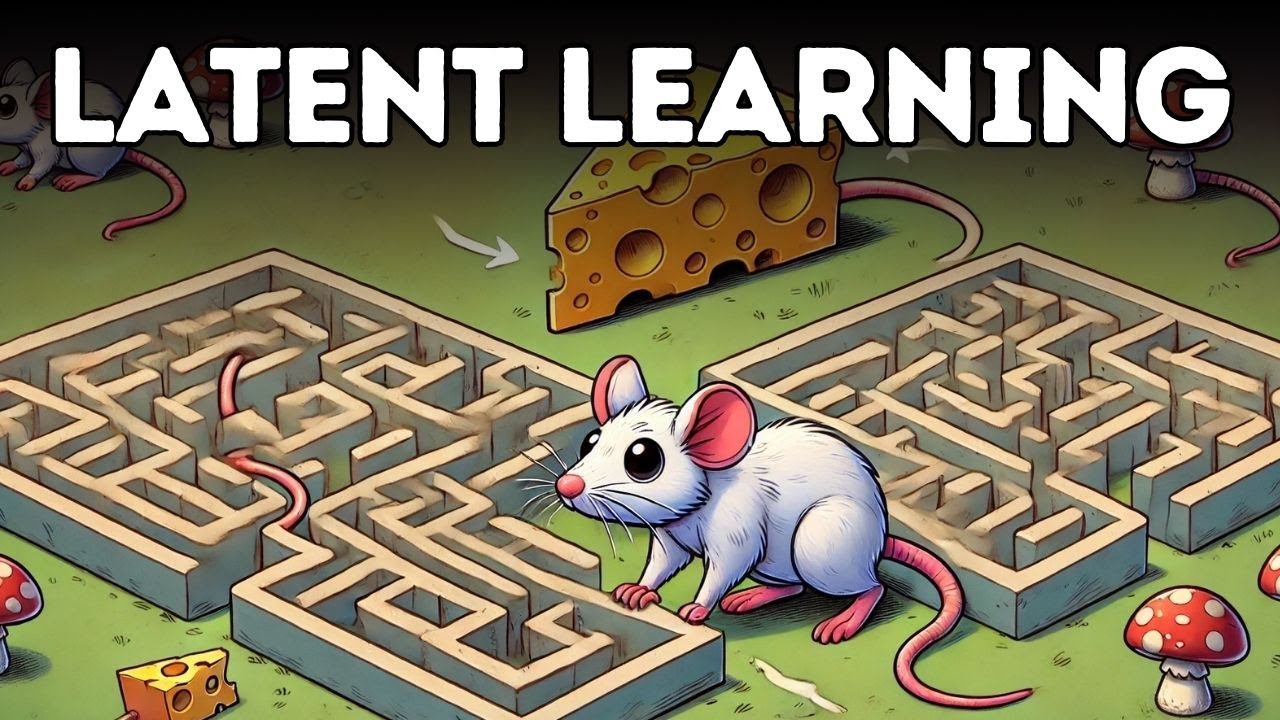
mazes demonstrated that learning could occur without immediate reinforcement he showed that rats that were allowed to explore a maze without rewards still formed cognitive maps of the maze when a reward was later introduced these rats navigated the maze more efficiently than those that had not explored it previously indicating that learning had occurred latently there are two main aspects of latent learning the first aspect is the acquisition of knowledge or skills without immediate
reinforcement individuals can learn from their environment and experiences even if they are not immediately rewarded or punished the second aspect is the delayed demonstration of the learned behavior the knowledge or skills acquired through latent learning are often not immediately apparent and may only be demonstrated when there is a motivation or incentive to do so here are two examples of latent learning first consider a child who frequently
rides in the car with their parents although the child is not actively trying to learn the route they might later be able to navigate to a a familiar destination on their own having formed a cognitive map of the area through repeated exposure second think of an employee who observes how their colleagues handle certain tasks at work without being directly taught or asked to perform these tasks the employee might later be able to complete them
efficiently when required Having learned the procedures latently through observation let's look at three benefits of latent learning first latent learning demonstrates that individuals can acquire Knowledge and Skills passively which can be useful in environments where active instruction or reinforcement is not always possible second it highlights the importance of exposure and experience in the learning process suggesting that learning can
occur through everyday interactions and observations third latent learning can lead to more flexible and adaptive Behavior as individuals can draw on their latent knowledge when faced with new situations or challenges now let's explore three criticisms of latent learning first latent learning can be difficult to measure and observe as the knowledge or skills acquired are not immediately demonstrated this can make it
challenging to assess the effectiveness of latent learning second the lack of immediate reinforcement might lead to less motivation for individuals to engage in the learning process as they may not see the immediate benefits of their efforts third latent learning might not be as effective for tasks that that require explicit instruction and practice as some skills and knowledge need direct reinforcement and feedback to be mastered to learn about other
common Concepts in education check out the videos on the screen or the links in the pinned comment