Ridddle · Transcript · · Updated
What Will You See in 4th Dimensional Space? – Transcript
Video by Ridddle · Watch the original on YouTube
Summary
AI-generated from the transcript. Verify details against the source video.
- Space has three dimensions while time represents a separate dimension, and a hypothetical person in a four-dimensional world could throw a ball in an additional direction.
- Scientists and mathematicians study higher dimensions through equations with four or more unknowns and indirect observations of superimposed effects.
- Physical passage to other dimensions is prevented by the freezing of the three dimensionality of space that occurred after the Big Bang.
Use this video with Pro
Reading, copying and transcript downloads are free. Create saved AI results for this video with a signed-in Pro account ($9/month).
Transcript
Search ignores accents. All transcript text stays visible.
In 2016, the Nobel Prize went to a group of scientists who, using sophisticated calculations, proved the existence of a fourth spatial dimension. Does this mean that we're on the verge of a new world and will soon be able to become invisible or to pass through walls?
According to space-time theory, space has three dimensions and there's also one dimension of time, but we'll not be discussing it in this episode. Try to imagine a four-dimensional world. We'll start from the simple and move to the more complex and discover how to picture worlds with additional dimensions.
In a general sense, a dimension is a direction in which an object can move. A world with zero dimensions is simply a point. If it becomes possible to move left and right, then space has become one-dimensional.
If we can now move up and down, it has evolved to 2D. If the point moves deeper, then that world, like ours, is three-dimensional. Is it difficult to imagine what it would be like to live in a space with fewer dimensions?
It's probably just as hard to imagine a mobile game that could beat Ray Shadow Legends in the mobile world. Ray has become an incredible sensation. This mobile RPG will turn your ideas about games of this genre on their head.
Over 15 million downloads in the last six months and an almost perfect rating in the App Store only confirm this. I'm also very pleased to present the game to you as the sponsor of this video. At your disposal are more than 400 Epic Champions, which you can customize and collect.
You can also build teams from 16 heroic factions, access 13 incredible locations, raid clan friends, or earn glory in the PvP arena. All this along with insanely beautiful and detailed graphics, and most importantly, it's absolutely free.
Also, every player has access to the automatic multi-battle mode. This means you can go about your daily business while the champion fights in automatic mode for you. So, you'll spend less time on training and have more time for battles with cool opponents. There are also weekly tournaments and other events where you can open special dungeons, fight in the arena, customize your heroes, compete and win valuable prizes.
If you've not played this awesome game yet, download it from the link in the description and get 100,000 silver to Clan Boss Keys 10 Mystery Shards in the first Executioner Champion, all free. The offer is available only to new players for the first 30 days.
Now, back to the current episode. Well, just ask the motorist who's stuck in a traffic jam if he's comfortable in this temporary zero-dimensional space, or ask a tightrope walker whether it's convenient for him in one-dimensional space since he's able to safely move only left and right.
Two tightrope walkers can meet along a rope but won't be able to pass each other, and even if we form the rope into a circle, the space will still be one-dimensional. Of course, people in these and similar situations are in a specific place, at specific coordinates, and remain three-dimensional like their world.
However, due to circumstances, they perceive the world in front of them at that specific moment as less than three-dimensional, since other directions of movement are impossible for them, ineffective or even dangerous.
Something similar occurs when we observe a three-dimensional object since we can't see what's behind it, as well as its backside. In this case, the three-dimensionality of our world is somewhat illusory. In fact, before us is a flat 2D picture, despite the seeming presence of depth and texture.
By the way, why did we decide not to discuss the dimension of time? You can throw the ball right, left, up, down or forward to your friend, but you can't throw it from today to tomorrow, since this would no longer be a measurement of physical space.
So, now that we've clarified these differences, just imagine, by analogy, a four-dimensional world. Easy, right? No, not so much, because then, according to the Australian mathematician Matt Parker, we'd have to imagine a dimension that's at right angles to the existing third dimension.
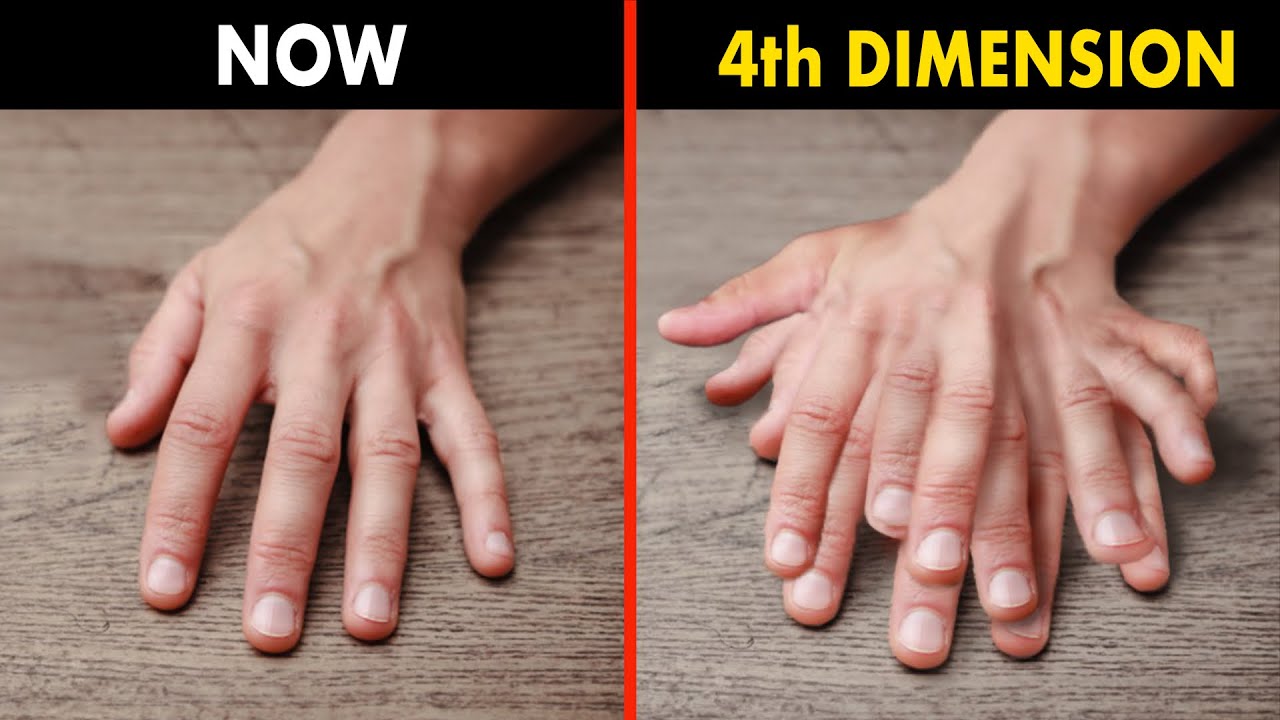
In fact, a hypothetical person existing in the four-dimensional world could throw a ball in some additional direction in which not only are we unable to throw it, but we can't even imagine it. However, people still try, since they're able to solve equations with four or more unknowns, allowing one to speculate about higher dimensions.
The limitations, according to another mathematician, William Thurston, are related to the fact that our brain evolved to process linear analytical information in one area and geometric shapes in another.
Speaking of the brain, Italian scientists Arthur Tozzi and James Peters believe that it does, in fact, function in four-dimensional space. After all, we know that there's a thought process, although we don't see how and in what area thoughts flow.
So, why do we have this limitation? Probably because human survival was in no way dependent upon the ability to see an additional dimension. That is, the reason is the lack of evolutionary necessity.
Nevertheless, we can get some idea of a more complex world and its properties through indirect observation. According to the results of two complementary experiments by European and American physicists, the effects of four-dimensional space are superimposed on our three-dimensional plane, which causes distortions.
This can be compared with the shadow of an object, which forms the idea of the object itself. And if three-dimensional objects cast two-dimensional shadows, scientists argue that three-dimensional objects could be shadows of four-dimensional ones that simply appear in lower dimensions.
Based on this, try to picture how, for example, the knitting process or a centipede would look in the 4D world. In order to get a better feel as inhabitants of such a universe, try to mentally picture such a four-dimensional analog of a three-dimensional cube or tesseract.
Consider a square and all of its sides. These are lines on one plane. Each side of a cube is represented by a square in space. And in a tesseract, which is a cube in the fourth dimension, the sides are cubes themselves.
To draw one, you need to take two cubes and connect the corners. Now, before you will appear a two-dimensional drawing of a three-dimensional projection of a four-dimensional cube. Looks weird, right? This is because its rotation looks deformed to us.
Can you imagine how many additional neural connections creatures from such a world must have in order to find a way in or out of their homes? Not to mention the residents of the ten-dimensional tesseract. It's probably better not to quarrel with these guys.
But first, you need to at least have an idea that objects of a higher dimension are in front of you. In 1884, in his best-selling book, Flatland, Priest Edwin Abbott fantasized about the perception of guests from more complex dimensions.
The main character, the square, lives in a 2D world called Flatland and is surrounded by circles, triangles, and rectangles, but sees these other shapes as just structures with the same lines until one day the mysterious Lord's fear appears.
For a flat man, it looks like a circle that first expands and then decreases in the same magical way. That is, it's visible only in cross-section in order for the square to understand what other shapes that have depth are.
The sphere transfers the square back to his own world. Now the square has seen the light and suddenly puzzles the sphere with a question. But what's beyond this? Like the square at the beginning of the story, we can't imagine a world with an additional dimension.
But we can take a guess at what things might come in handy there. Just imagine that someone like Lord's fear has invited us there. So prepare your suitcase. First, we need a heat shield. You don't want to get burned by the 4D world in which, according to physicist Richard Morris, the planet starts spinning towards the sun due to the imbalance between gravity and centrifugal force holding it in orbit.