The Virtual Linguistics and Literature Campus · Transcript · · Updated
SEM101 - Semantics - An Overview – Transcript
Video by The Virtual Linguistics and Literature Campus · Watch the original on YouTube
Summary
AI-generated from the transcript. Verify details against the source video.
- Semantics is one of the central areas within linguistics that studies how words or sentences acquire meaning and how native speakers assign stable interpretations.
- Semantics relates to phonology, morphology, syntax, and pragmatics, while also being studied across disciplines like philosophy, psychology, semiotics, cognitive science, and artificial intelligence.
- The main goals of semantic analysis include describing the meaning of isolated words, contexts, sentences, and complex or multi-dimensional combinations systematically.
Use this video with Pro
Reading, copying and transcript downloads are free. Create saved AI results for this video with a signed-in Pro account ($9/month).
Transcript
Search ignores accents. All transcript text stays visible.
this first e-lecture of the VLC semantics and pragmatics class discusses the contribution of semantics to the study of language and provides an overview of other academic disciplines within interest in the subject furthermore it outlines several issues related to the description of meaning in particular we will look at the role of semantics Within
Linguistics as well as the role of semantics in other disciplines and we will discuss the central goals and objectives of semantics now the term semantics originally a Greek term is a recent addition to the English language however in its early use in the 19th century the term was not used simply to
refer to meaning but to its development what we today call historical semantics despite additional attempts around 1900 the term did not catch on until Ogden and Richards published their now famous book the meaning of meaning in 1923
today semantics is one of the central areas within Linguistics with ambitious goals and numerous applic ations and influences but also one of the most problematic ones linguists working within semantics study the ways in which words or sentences acquire meaning and the processes by which native speakers of a language can assign stable
interpretations to word strings since meaning can be influenced by various linguistic factors semantics plays an important role in most branches of Ling Linguistics with the exception of phonetics and of course semantics itself this is why we erased it over here let us look at some
examples let's start with phology in phology the study of the sound systems of particular languages semantics is related to meaning studies in several ways phones can distinguish meanings by means of establishing so-called minimal
pairs such as Ben and Pen we can show that the exchange of one phone by another one so B and P over here that the exchange of one phone by another one leads to a difference in meaning thus the two items must be two different
phones the sound system also carries meaning through the patterns of stress that we adopt in speaking cases of lexical stress in present day English where we have examples such as contrast and contrast export versus export now cases like these where the
placement of stress Within A Word changes the word class are well known or take a simple sentence such as Jim enjoys playing country songs in bars now here the choice of the nucleus influences the meaning of the sentence Jim enjoys playing country songs versus hip hop songs in bars or Jim enjoys playing country song in bars versus in
concert Halls well and finally variations of pitch may lead to different tonal effects and by means of tonal effects we can influence the meaning of several chunks of speech we can create different sentence types such as Mary passed her exams yesterday which
is a declarative sentence but with a rising tone on yesterday Mary passed her exams yesterday we can easily create an intonation question or we can indicate the end of a list by means of a falling intonation milk water juice and wine Sorry by means of a falling tone so tonal differences may lead to
the change of the meaning of words and sentences let's look at morphology next now morphology studies the internal structure of words and how words are built out of smaller components there are three Central processes but they differ with the respect to the degree of semantic transparency of the word forms they
produce inflection is semantically fully transparent so let's mark this with a plus symbol inflection doesn't involve a change of the basic forms meaning and the a if there is one can clearly be associated with a fixed meaning take the
present day English AIX Ed here represented orthographically which clearly means pasttime reference in derivational processes the meaning of the affixes involved is in many cases not clearly definable so we should add a minus here that is the affixes cannot be
straightforwardly associated with a fixed meaning unlike inflectional affixes they are semantically non-transparent an example is the AIX ion in items such as destruction election qualification and then there are compounds they can be fully transparent
as an endocentric compounds such as school boy or school girl a school boy is a boy a school girl is a girl or totally intransparent as in exocentric compounds such as pick pocket which is not a type of pocket or red skin which which is not a type of
skin let's continue with syntax syntax investigates how words combine into successively larger structures to form phrases and sentences semantics deals with the way the resulting syntactic structures are interpreted and the syntactic structure of a sentence determines its semantic
interpretation to a considerable extent for example if we swap around the elements in the present day English the lion chases the mouse we can create a totally different meaning by changing the word order so let's create a new sentence like this well and here you clearly see we have a different meaning this is because
the parts of the sentence are structurally related to each other and in present day English this structure is reflected in the word order the exact division of labor between syntax and semantics and the way they interact that is their interface are among the most interesting and Central but also the most controversially discussed issues in linguistics let's look at pragmatics
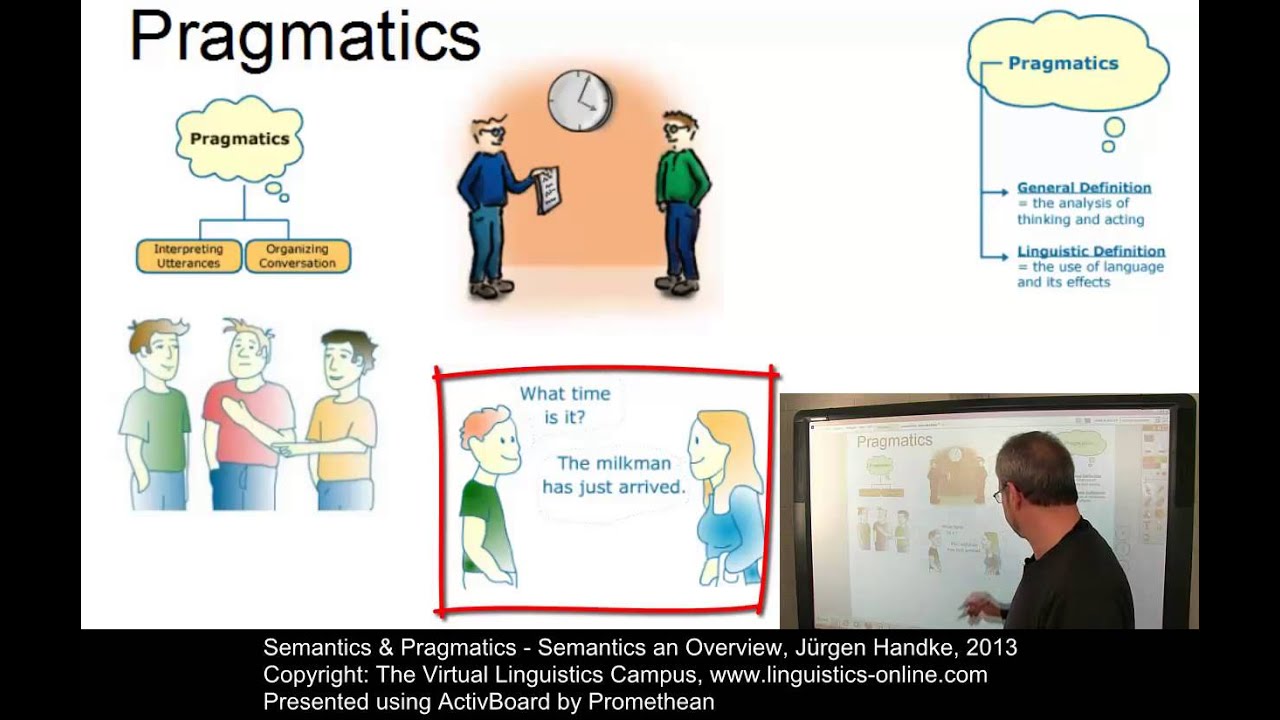
next now drawing the line between semantics and pragmatics is difficult and controversial since both fields are concerned with the transmission of meaning through language however we might say that whereas semantic studies meanings abstracted away from language users and sit situations pragmatics is concerned with the meanings that linguistic Expressions have in
particular contexts in which they are uttered and with various functions that speakers assign or choose to perform with them in trying to determine what someone actually wants to say people regularly go beyond the conventional meanings of the words spoken by taking into account contextual
aspects now to understand the girl's answer in this dialogue what time is it the Milkman has just arrived you have to interpret the situation the participants the history of the interaction and so on and Beyond Your World Knowledge you have to have the ability to draw inferences conclusions for example that it is 8:00 because the Milkman generally arrives at
around 8 let's now look at the contribution of semantics in other disciplines linguists are not the only Scholars with an interest in semantics in fact meaning is studied in various other academic disciplines some of which are represented on this flip chart behind me while there's a significant degree of overlap among these disciplines as well as as with linguistic semantics they all have
something idiosyncratic and unique in their approach let us look at them in more detail and let start with philosophy while linguists take the notion of meaning as given and start working from there the philosopher takes one step back and asks questions like how is it possible for anything to mean anything or what sort of relation must
hold between X and Y for it to be the case that X means Y and so on and so forth highly philosophical issues researchers working in the area of psychology of language or psycholinguistics are concerned with a number of fundamental questions related to the mental processing of meaning how is meaning represented in
the human mind is such a question or what mechanisms are involved in encoding and decoding linguistic messages and last but not least how do children acquire meaning psychological and psycholinguistic Frameworks commonly take an experimental approach to find answers to these
questions in semiotics the study of signs language is viewed as one symbolic system among many linguistic meaning is regarded as a special subset of the more General human capacity to make one thing stand for another that is to identify and create signs semioticist are interested in the types of relationship that may hold
between a sign and the entity it represents which include the following iconic relationships arbitrary relations and conventional and discrete relations between sign and symbol cognitive science the next
discipline I would like to mention is an interdisciplinary approach bringing together what is known about the human mind from Linguistics psychology computer science and philosophy it seeks to answer the following centr questions what sources of knowledge do humans utilize in speaking hearing and
thinking or how is knowledge organized and represented in the human mind and how is this knowledge put to use and what cognitive processes underly the application of this knowledge semanticists inspired by the ideas of cognitive science see see language as part of our general cognitive ability