Jeremy Miner · Transcript · · Updated
2026 Cold Calling Techniques (He Trained 1 Million Sales Reps) – Transcript
Video by Jeremy Miner · Watch the original on YouTube
Summary
AI-generated from the transcript. Verify details against the source video.
- Jeremy Miner explains that standard cold calling approaches often trigger fight or flight mode and cause prospects to put their guard up immediately.
- Jeremy Miner introduces pattern interrupts like holding physical papers to trigger curiosity and disarm prospects within the first few seconds of a call.
- Jeremy Miner details selling the exit by pushing prospects away or asking who is responsible for specific hidden gaps to lower their guard.
Use this video with Pro
Reading, copying and transcript downloads are free. Create saved AI results for this video with a signed-in Pro account ($9/month).
Transcript
Search ignores accents. All transcript text stays visible.
I'm going to show you exactly what top 1% of salespeople are doing right now in 2026 to crush cold calling even in the first 30 seconds. Now, what I'm going to show you works in every industry and by the end, you're going to be able to use it for what you sell as well. So, you want to pay attention to this training.
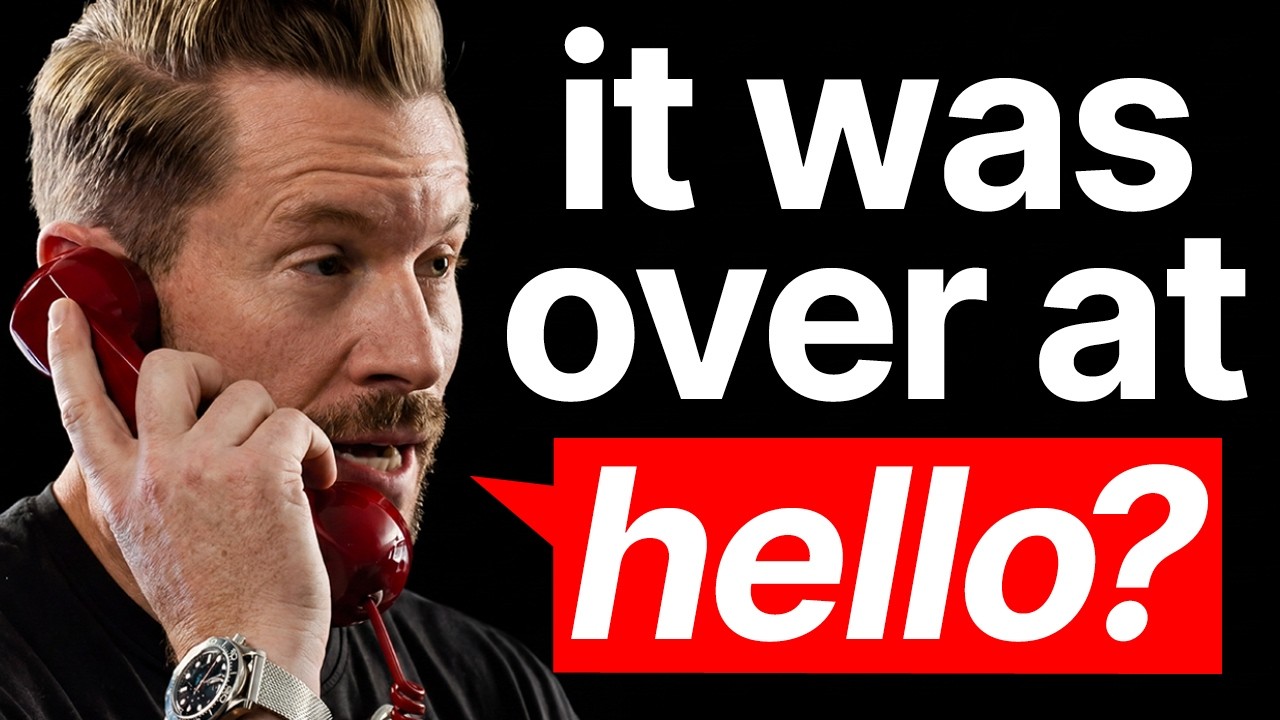
Most salespeople lose a sale before they even finish the first few sentences of that conversation. How you came across, the tone triggers what's called fight or flight mode in that prospect's brain. The prospect's guard goes up. We're not interested. We already have somebody and it's over at hello. Look, I've spent the last 25 years studying the behavioral science behind why people decide to trust, buy, and commit at the highest level. And once I show you how, selling will never be the same for you in a good way. Let's go and jump in. So, here's what happens. The prospect answers the
phone. Within the first three or four seconds, the subconscious part of the brain is already looking for patterns. Now, why is that? The brain is asking one question. Is this person someone I can trust? Am I safe? If the answer is yes, it triggers curiosity and they start to open up to the conversation. If the answer is no, then the sale is pretty much over. It's dead. Most salespeople have been told that selling is just a numbers game. Call as many people as you can, you know, get all those no's to get that one yes. And look, that sucks. Like, nobody wants to
get rejected 99% of the time. Look, nobody tells a surgeon just to do more surgeries and eventually one will work out, right? They have to get the skill, right? Now, why is this so critical for you to understand? The rep who talks to, let's say, 10 prospects that has the right framework, the right skill level, is going to outperform the rep who talks to 50 prospects that doesn't have the skill level every single day. All right, come over here with me. Let's go over the numbers game strategy most people have been taught. There's typically two
ways. Number one is the standard "Hi, my name is I'm with XYZ company and the reason why I called was" and then we try to say as much as we can to get as much words out of our mouth, information, and hope and pray the prospect is going to be interested. As you know, most people are like, "We already have somebody for that. Uh I'm not interested. Is this a cold call?" And it's pretty much over 99% of the time with this approach. Lots
of rejection. You don't want to stay here, okay? Or, this is I've heard this, you know, probably in the last five or six years. This works a little bit better. They answer is like, "Hey, John. Hey, full disclosure, my name is blank. This is a cold call. If you can give me 2 minutes of your time, I'm going to go over how we can do XYZ and then you can judge if you want to keep talking. Fair enough." Or something like that. Now, I would say this works a little bit better, but you're still going to get rejected most of the time. They might
even hear you. Typically, they'll hear this out maybe 30 seconds or maybe a minute or two. And at the end, when you go through what you do, they just say, "I'm not interested" or "We already have somebody for that." The question is, why do they not work, okay?
When this happens, your prospect's brain recognizes patterns just like we all do. Our brain keeps us safe. So, if, you know, if we hear something in the jungle back there like a tiger lurking around, we hear a noise, we immediately react to that. In our day and age, what is not safe? Salespeople trying to manipulate, sell something to us that maybe we don't want. The society in general views salespeople as like high status or more low status? Low status, right? So, when
we hear somebody come across "Hi, my name is I'm with XYZ company. The reason why I called was", instantly our guard goes up. We've heard that or some type of that before and instantly like salesperson, danger, guard goes up. So, we want to eliminate that. That's just a defensive mechanism that we are triggering by what we're saying and how we're saying it. I'm going to show you different word tricks to use to stop that from happening to you, okay? If our tone sounds like a salesperson, especially if it's monotone. "Hi, is
this John? Hey, John, it's Jeremy Miner with XYZ company. Hey, the reason why I called you was", the brain instantly guard up. Monotone sounds like a telemarketer. Or if I'm way too excited when I call. I don't mean be boring. There's a middle ground. Or if I come across more like timid or or nervous or anxious, it triggers the brain to get their guard up, okay? Throw out objections. We don't want that. We want to show you a different way. So, how do we learn how to trigger curiosity even
in that first five, let's say, 10, 15 seconds in the prospect's mind that causes them to want to engage with us. That is the million-dollar question. This is called a pattern interrupt. I'm going to show you different pattern interrupts. I'm going to show you generic pattern interrupts. And I'm going to show you different industry-specific ones to help you craft one for what you sell as well. So, you want to pay attention to this. The pattern interrupt and how do we use what's called a familiar tone. And sometimes, depending on the context, we
might even use a little bit of a confused tone. Now, when I say confused tone, I don't mean like, you know, you're 107 and you got dementia and you're like, "Oh, I don't know how it works." Confused in like you're not quite sure if they're the right person you should be talking to. That little bit of that confused tone. I'm going to show you examples of that as well. So, I want you to write this down. This is called an NEPQ problem statement. Now, if you're not one of our clients yet, NEPQ stands for neuro emotional persuasion questions. It's a methodology I developed in my years uh going to school to become a psychologist and then
the 17 years as a salesperson before I started this company. So, the prospect answers and you're immediately going to go into it. "Mary, hey, it's it's Jeremy. Jeremy Miner. I'm holding a copy of your blank and I was wondering if you could possibly help me out for a moment." Now, one thing I will show you that we train our clients, but when you cold call, quite literally, you can hold a copy of something. And when you say "I'm holding a copy of your blank", I'm crinkling the papers. Now, why does this work? Because the prospect hears
crinkling of papers. And when you say "I'm holding a copy of blank", let's say, "I'm holding a copy of the 2025 regulations for XYZ", I was wondering if you could uh possibly help me out for a moment. "I'm holding a copy of your property tax records of the house there on Willow Lane. I was wondering if you could help me out for a second." It just triggers massive curiosity. They hear the papers, so it sounds like what you're saying is real. When I was on the floor as a salesperson like you, I heard
so many reps that would just go through the motion, calling lead after lead. "Hi, is this blank? Hey, I'm with XYZ." And they just sounded monotone like telemarketers and they wondered why seven out of 10 of everybody I talked to was booking to the next step call where they were getting maybe one out of like 50 they talked to. There's a big difference in that, okay? So, I'm going to write into "Hey, it's it's Jeremy.
Jeremy Miner. I'm holding a copy." Now, why do I have these periods here? That's called a verbal pause. I want you to write that down. This is a familiar tone. So, I want you to write down familiar tone. Now, why do you want to use a familiar tone when you're cold calling? If you ever got a call from somebody like, "Hey, it's it's Bill.
Bill Bill Smith. How are you?" What do you do? Uh I'm I'm good. How are you? And then your brain, as they start talking, does what? Who's Bill Smith? How do I know Bill Smith? He sounds familiar. You never say, "Who is this?" because their tone, their voice sounds like they already know you. So, your brain is analyzing. It gives you more time. It's a pattern interrupt. It's breaking the pattern of the prospect's brain. Whereas like, "Uh who's Bill Smith? Did I meet Bill Smith at a networking event? Did I meet him at a dinner? Who is this person?" And you just go with it. You've probably done
that before yourself, okay? And so, "I'm holding a copy of your blank and I was wondering if you could possibly help me out for a moment." Now, let me show you this. These are pattern interrupts here, okay? So, I could say "I'm holding a copy of your blank", okay? I could say, let's say if I'm a marketing agency.
"Yeah, I'm on your website looking at blank and I was wondering if you could possibly help me out for a moment, okay? Or I'm holding a copy of the new 2026 XYZ law on blank." It's got to be something that has to do with what you're calling or something that you solve for them, okay? "Or I was looking at your blank and I was wondering if you could help me out for a second, okay?"
That triggers curiosity. It triggers engagement. Now, the important thing here is, when I'm doing this, see I'm holding a copy of your 2026 property taxes on your XYZ Willow Lane home. I was wondering if you could possibly um help me out for a moment." See how I'm a little bit confused? I'm doing that because I want to trigger curiosity. Now, here's my question. Is that something you're doing to people or is that something you're
doing for people? Well, you're doing that for people because if you can't get their guard down in that first 10 or 15 seconds, they don't open up, they get rid of you, and they don't buy what you're offering, you can't solve any of their potential problems. So, I have to learn how to disarm them to get them to open up. If I can't, I offer them no value. So, you're always doing that for them, okay? Selling something you're doing for them, not to them. Now, right when they do that, most of the time, like especially if you use this familiar
tone. "Yeah, it's Jeremy. Jeremy Miner. I'm calling." See? See that little verbal pause? "It's Jeremy. Jeremy Jeremy Miner." Like, they should know me, okay? Now, right when that happens, this is really critical for you, okay?
You have to have certainty in your voice. I see a lot of reps try to do this, especially if they're not clients because they don't understand the ins and outs of this. They don't know how to role play with this. They're not trained how to really apply it. They just hear it on a a YouTube video like this and they think they're going to master it. So, you want to be able to have certainty in your tone. Like, you are the expert. You're there to help them. A lot of reps sound really uncertain, like timid and
nervous, and the prospect's like Spidey senses go up and it's over. So, right when that happens, they're like, "Uh sure. How can I help you?" Or they'll say, "Uh sure. Who is this again?" Yeah, it's it's Jeremy. Um and I'm not even sure if it makes sense for us to talk.
Now, there's different openers here I can do. One thing I want to do right here, and I want you to write this down. This is called selling the exit. Now, why is it important for you to learn this? Because what's my first job when I cold call? To get the guard down.
If the guard's up, it's over. So, I want to sell the exit. "Well, I'm not even sure if it makes sense for us to talk." See how I'm kind of pushing them away? Or, I could use this frame here. "Well, I'm not even sure if you're the right person I should be talking to. I called to see who would be responsible in your company for looking at any possible hidden gaps in your blank that could be causing the company to blank. Hidden gaps in what? I'm going to show you what the plug-in. Usually hidden gaps, let's
say if I'm a market agent, hidden gaps in your lead generation or hidden gaps in the quality of your leads that could be causing the company to lose sales they could be making. See, I'm going to repeat back the consequence, the negative thing that I can solve for them. Now, why do I do that? Because that triggers more curiosity. Are you with me on this?
Okay, this is very important. Then at the end, I'm going to simply say, "Who should I be talking to about that?" So, let me go through it with you again, okay? "Yeah, I'm not even sure if if you're the right person I should be talking to. I called to see who would be responsible in your company at looking at any possible hidden gaps like in your like the way you guys are running your cards that could be causing you to overpay every month. Who should be talking to about that?" See how I'm doing that? So, I'm focused on a problem
and the consequence of a problem that most people I'm talking to. This is key, right? I'm going to come over here. That most people I'm talking to can associate with. They know about this problem, they talk about these issues. I always want to plug that right in. Are you getting that? Okay, very important here. Let me give you a few examples of how this might look, okay? And once again, pay attention to the framework, not the industry stuff. I'm just going to give you three or four industry specific examples. They might not be yours, but if you pay attention to the framework,
you'll be able to plug in what you sell in this. Now, if you sell door-to-door, there are some tweaks to this. This is mainly for the phone. There are some tweaks if you go in a person and if you go door-to-door, I'm going to try to get to those in this video, if not any other video, okay? So, right when they answer, let's say if I sold some type of software. I'm in SaaS and it has to do with AI. I pulled this example from one of our big companies that we train and what they do is they have an AI device that